The Motatapu area has an interesting history. Of use to early Maori, the Soho and South Motatapu Valleys offer a reasonably direct and somewhat easy linkage between Arrowtown and Wanaka. The area was also explored by European settlers, though early parties missed the low Soho / Golspie Burn saddle. The value of the route was lessened by the increasing availability of the Cardrona Valley, which offers an even more direct run while trading the difficult Arrow Gorge travel for a climb over the Crown Range.
The Motatapu area fell into private ownership, and later Crown lease. In 2004, it was onsold to a private overseas investor. As part of that transaction, a condition of purchase was added which required the addition of a walking track into the Soho / Motatapu Stations to preserve a remnant of public access into the area.
The route itself is generally walked from Glendhu Bay (near Wanaka) to Arrowtown, though either direction is passable. Heading southbound means finishing on the easy 4WD tracks of Macetown Road, but also leaves the main river crossing (of the Arrow River) till the final day and it's not always passable. One big benefit of finishing up in Arrowtown is that public transport is readily available every hour (the #2 bus will take you almost back to the airport), and there are shops and amenities - the Glendhu side is just a carpark on a gravel road, 3km from the nearest accommodation.
The alignment of the Motatapu Track seems a bit contentious. It allegedly follows "part of" an old pack track, which I can only assume is the final section over Roses Saddle and out via Macetown Road. The alignment of the northern aspects is certainly a choice, seemingly driven by the desire to avoid useful grazing areas. It goes up the very pretty Fern Burn, before passing over a moderate saddle (Jack Hall's Saddle) and then proceeding to bisect a range of spurs in a somewhat illogical fashion. Total elevation gain across the entire route is over 3000m, despite it being a ~500m elevation gain if you simply drove the farm tracks that follow the valley floors. It's an extremely pretty area, but by the fourth or fifth ascent of the day you might find yourself cursing the choice of trackline.
I had economy flights to Queenstown booked, and reluctant to incur the $50 change fee I decided to just go for it. The weather in the alps was poor, so poor that some of the high country rivers rose to the point of damaging bridges. Motatapu is quite far east and avoided most of the rain, though certainly not the high winds. Anything from the north will absolutely blast the route, as there is no natural protection - winds scream across Lake Wanaka and up the Motatapu, which is something to consider.
It was a long and convoluted trip down. Leaving Palmerston North at 5:45am, I reached Wellington Airport two hours later and made it through security screening. The flight down was slightly held up due to runway availability, but fortunately so was the shuttle to Wanaka. After just over seven hours of travel and transiting, I was in Wanaka and ready to collect my groceries. I had bought seat-only fares, so it was a bit of a mission to meet the weight and size limits with enough gear for the three days.

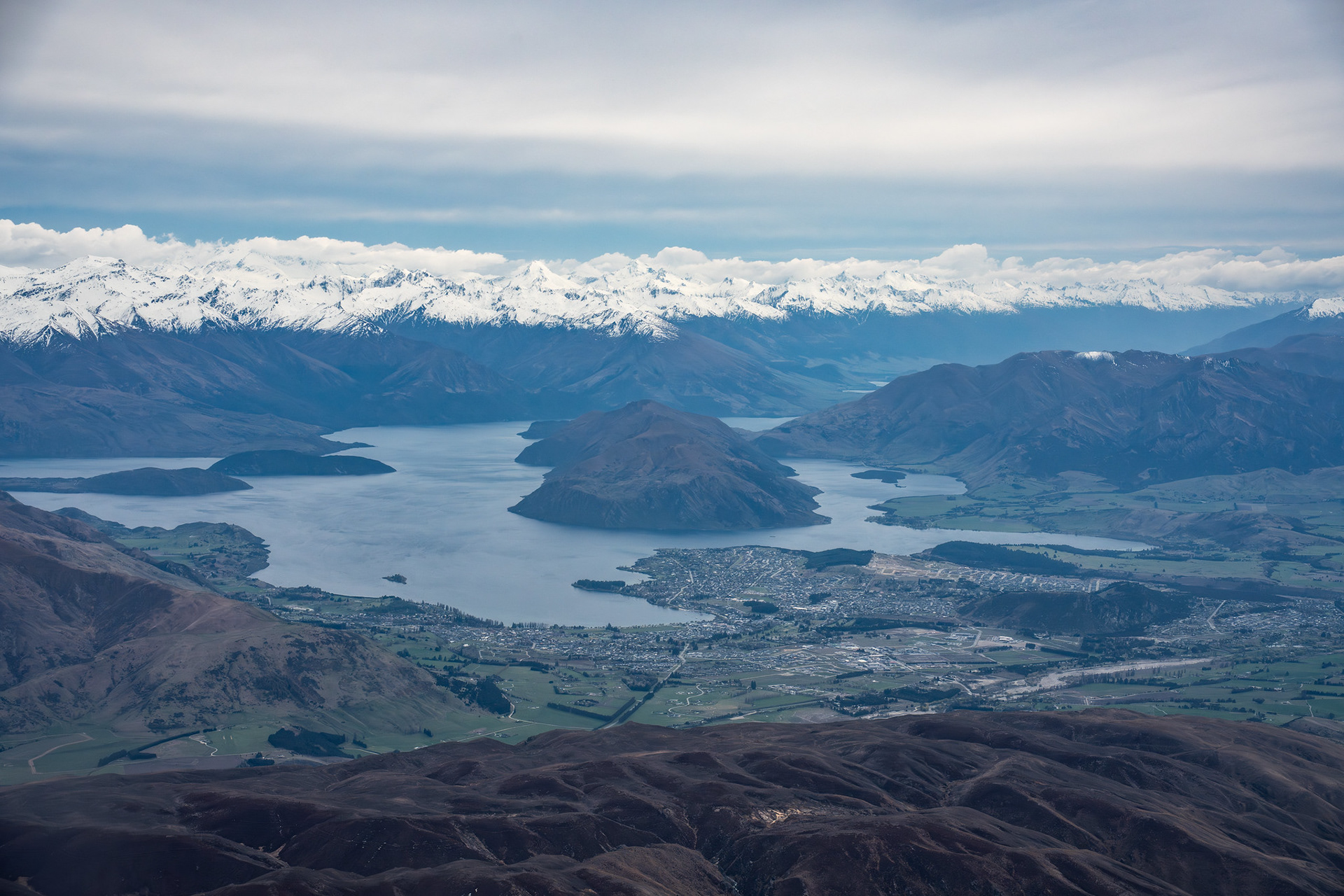
Flying past Wanaka on the way down, Glendhu Bay is just out of shot to the left.
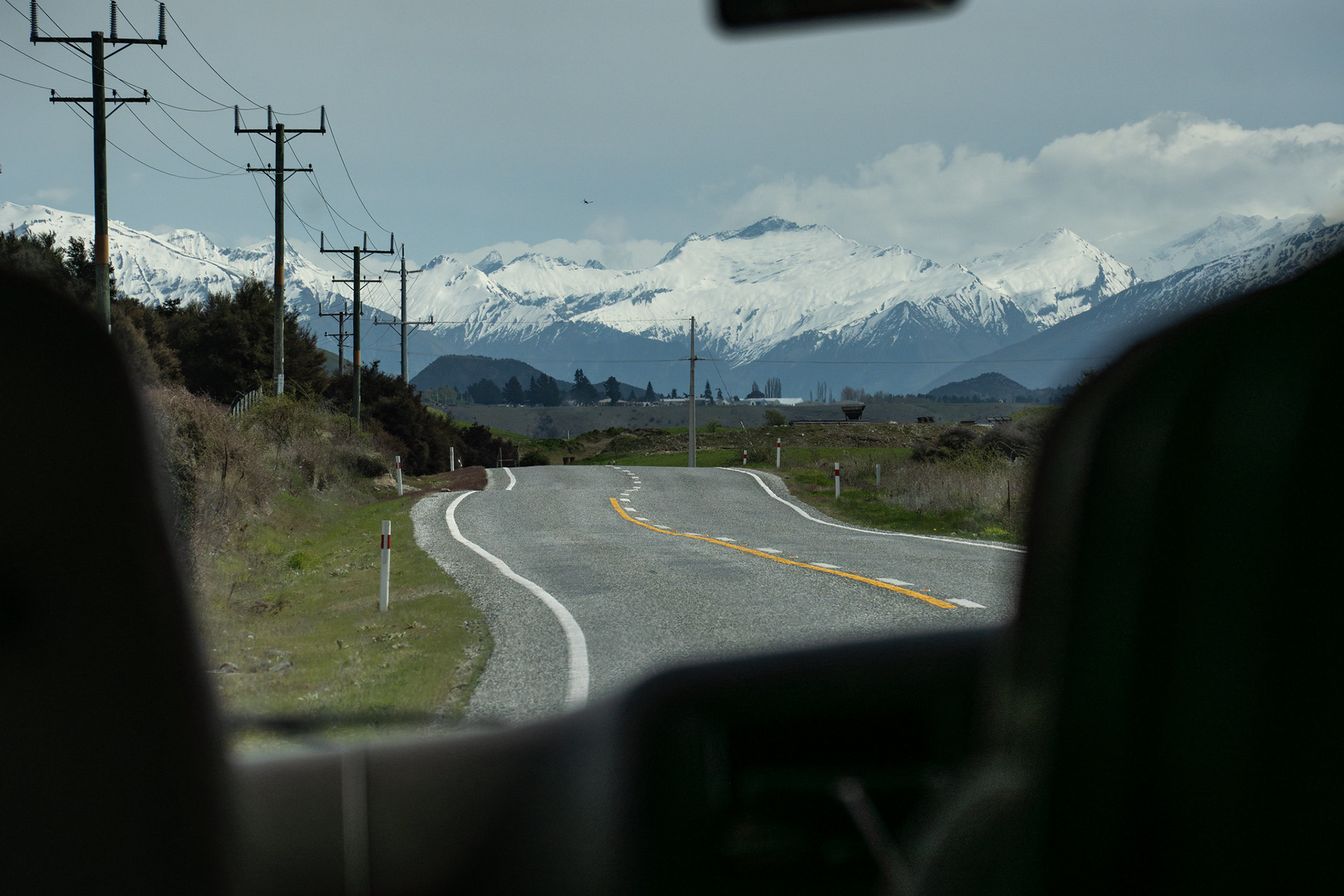
On the shuttle to Wanaka, currently $40 with Ritchies.
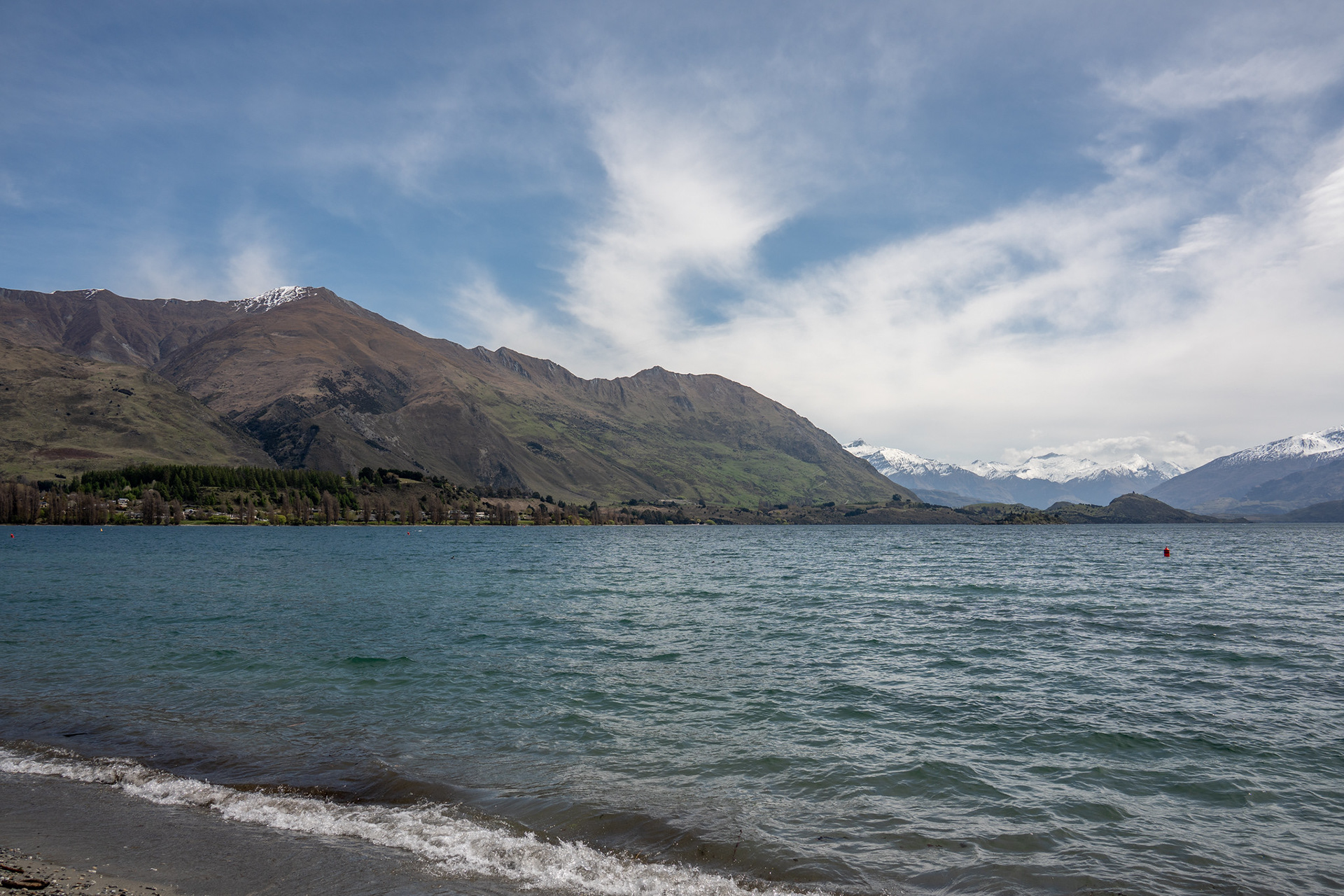
Getting from Wanaka to the track start is about 15km, roughly $60 for a taxi. If you have multiple people, this is the obvious choice. If you don't, you have the option of walking. The road walk is more direct, but the Millennium Trail along the peninsula is more scenic. If you follow the latter, it's about 18.5km to the track start - a bit of a mission before the trail proper has even started! There are nice views across the lake during the walk, particularly in the latter half with Fog Peak particularly notable. Mt Aspiring / Tititea is also visible up the Matukituki, though the distance as the crow flies makes it more of a speck amongst a sea of snowy peaks.

Setting out from the lakeshore in the township, Roys Peak is visible in the distant centre.
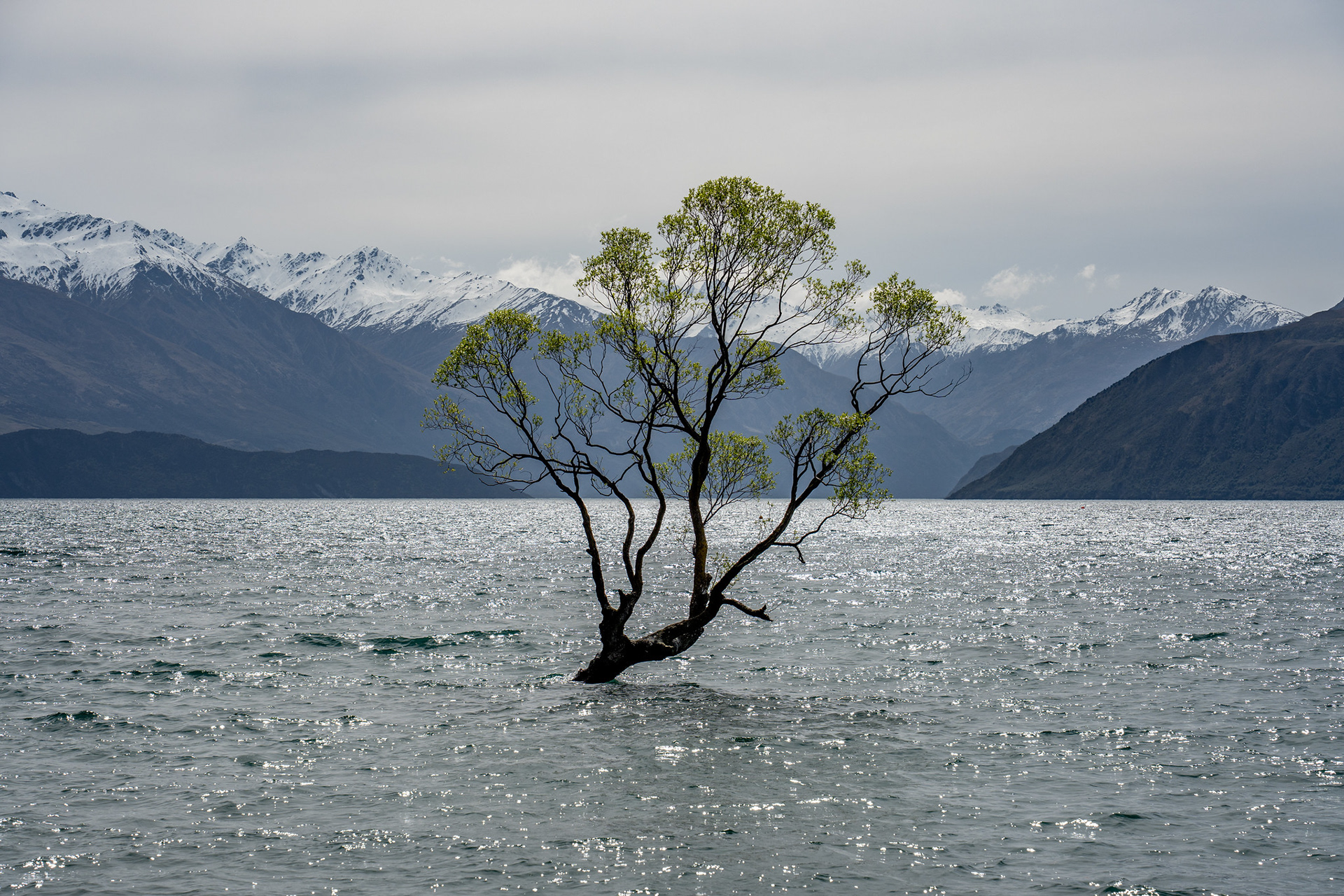
If you're social-media happy, the lakefront walk goes past the Wanaka Tree.
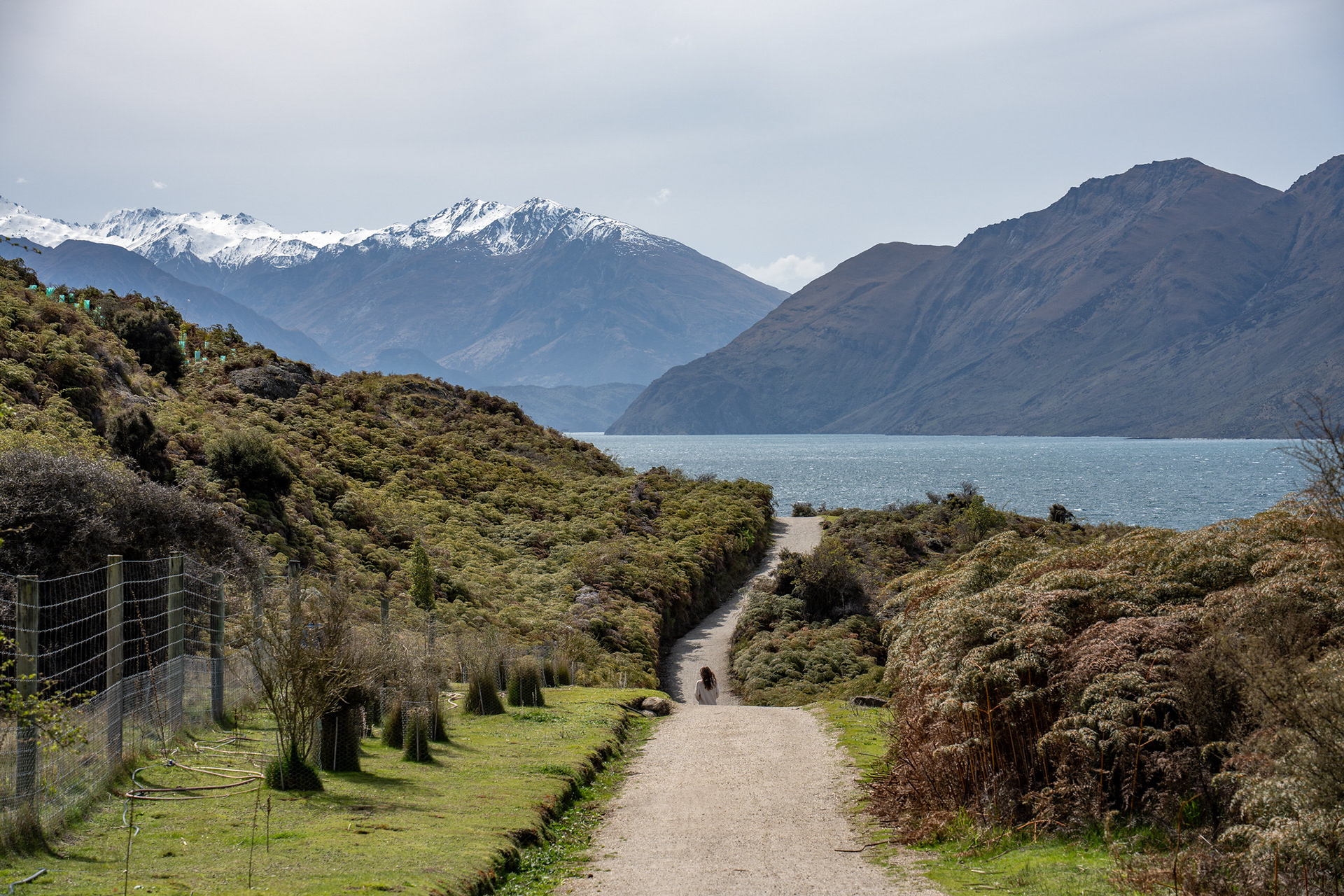
Onto the Millennium Trail proper now, as it works its way around the peninsula.
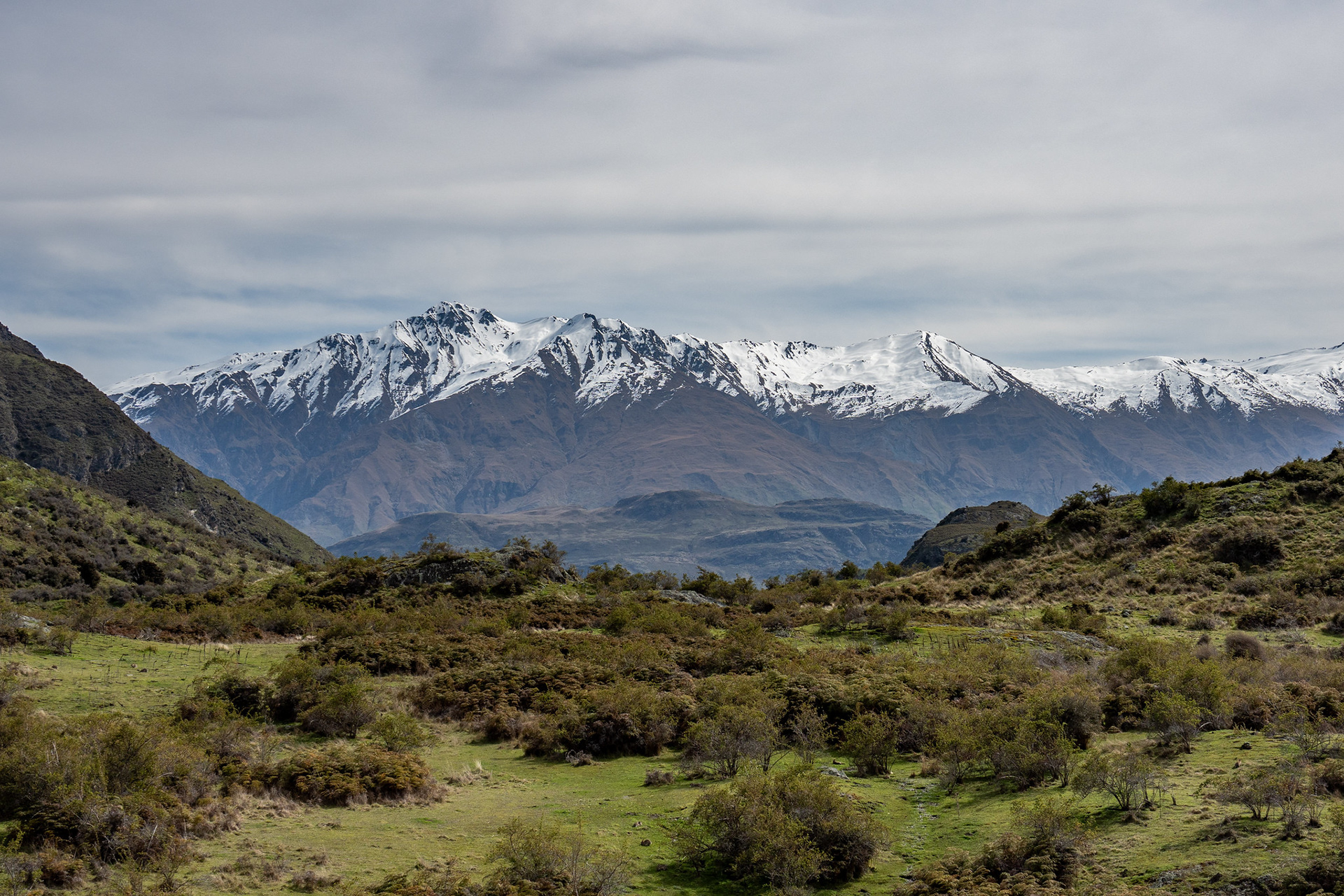
Across a flat part of the peninsula to End Peak, it's prominent throughout most of the walk and the Motatapu Track.
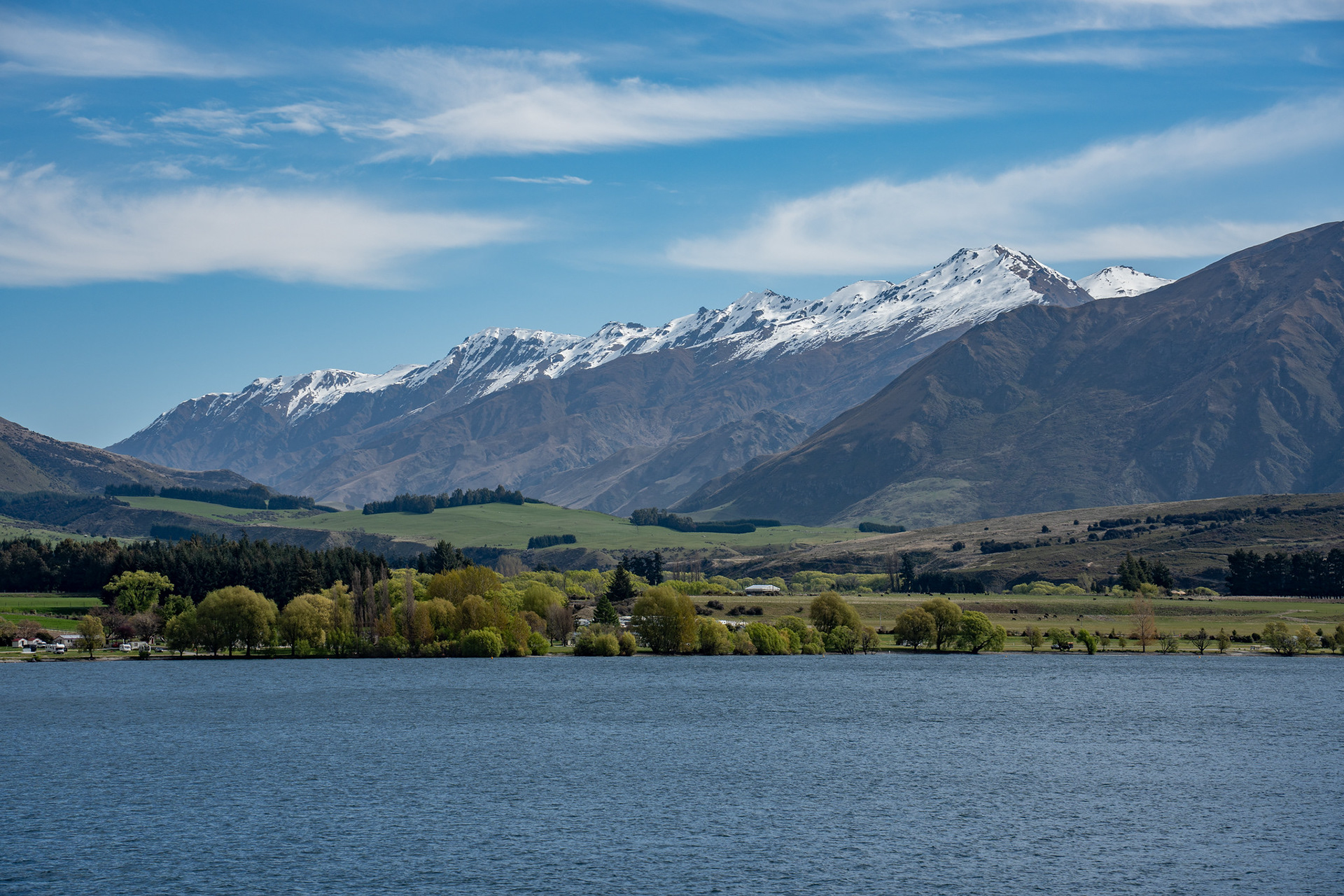
Looking up the Motatapu Valley from Glendhu Bay.
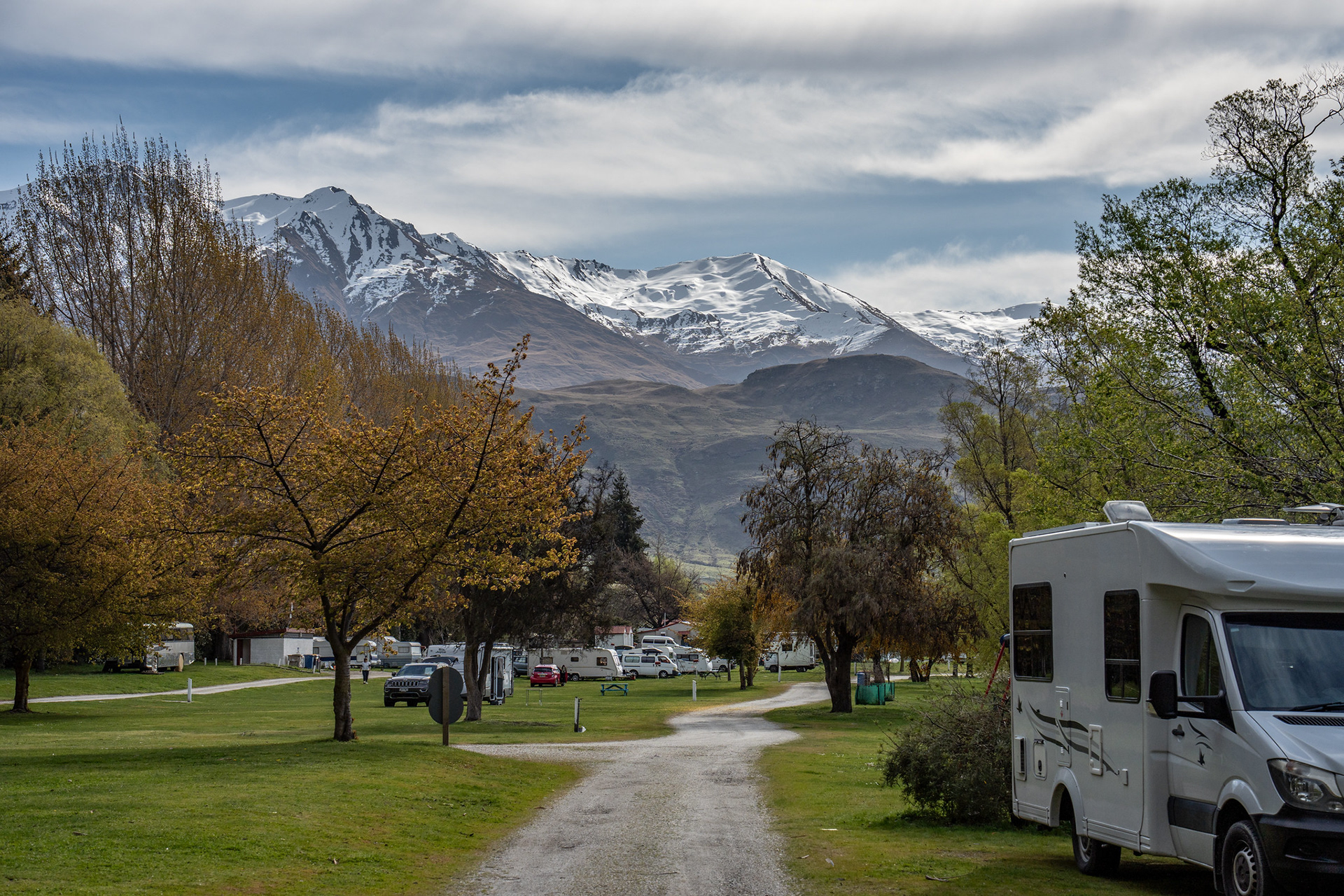
If you do follow the peninsula, the route reaches Glendhu Bay and then follows a new section of trail (presumably built for the TA) which runs between the road and the lake. It leads into the holiday park, which allows pedestrian access through its roads for quite a distance. I don't actually know how you're supposed to exit the park to access Motatapu Road - I had to jump a fence, but perhaps there is a pedestrian gate somewhere I missed. Either way, you can follow a pedestrian path that runs alongside the road for a short while (to the Bike Glendhu turnoff) before it's another few kilometres of road walking. There is a carpark here, though given the start and finish of the Motatapu are 70km apart by road, it probably doesn't see a massive amount of overnight usage.

Heading through the Glendhu Bay holiday park, a very scenic backdrop. Surprisingly affordable too, if you wanted to overnight here like some TA walkers do.
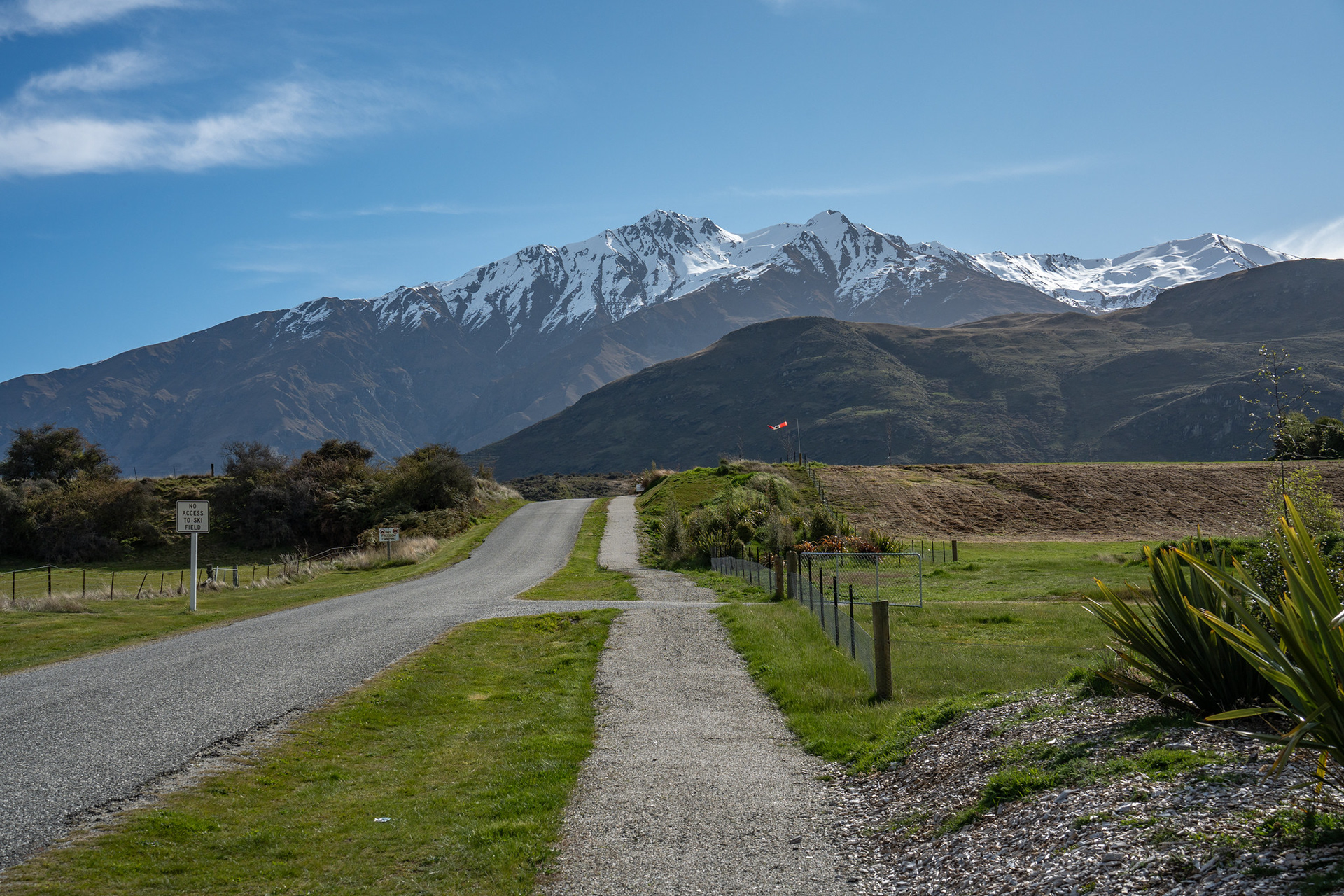
Wandering beside Motatapu Road, there's a footpath initially until the Bike Glendhu turnoff then it's back onto the road.
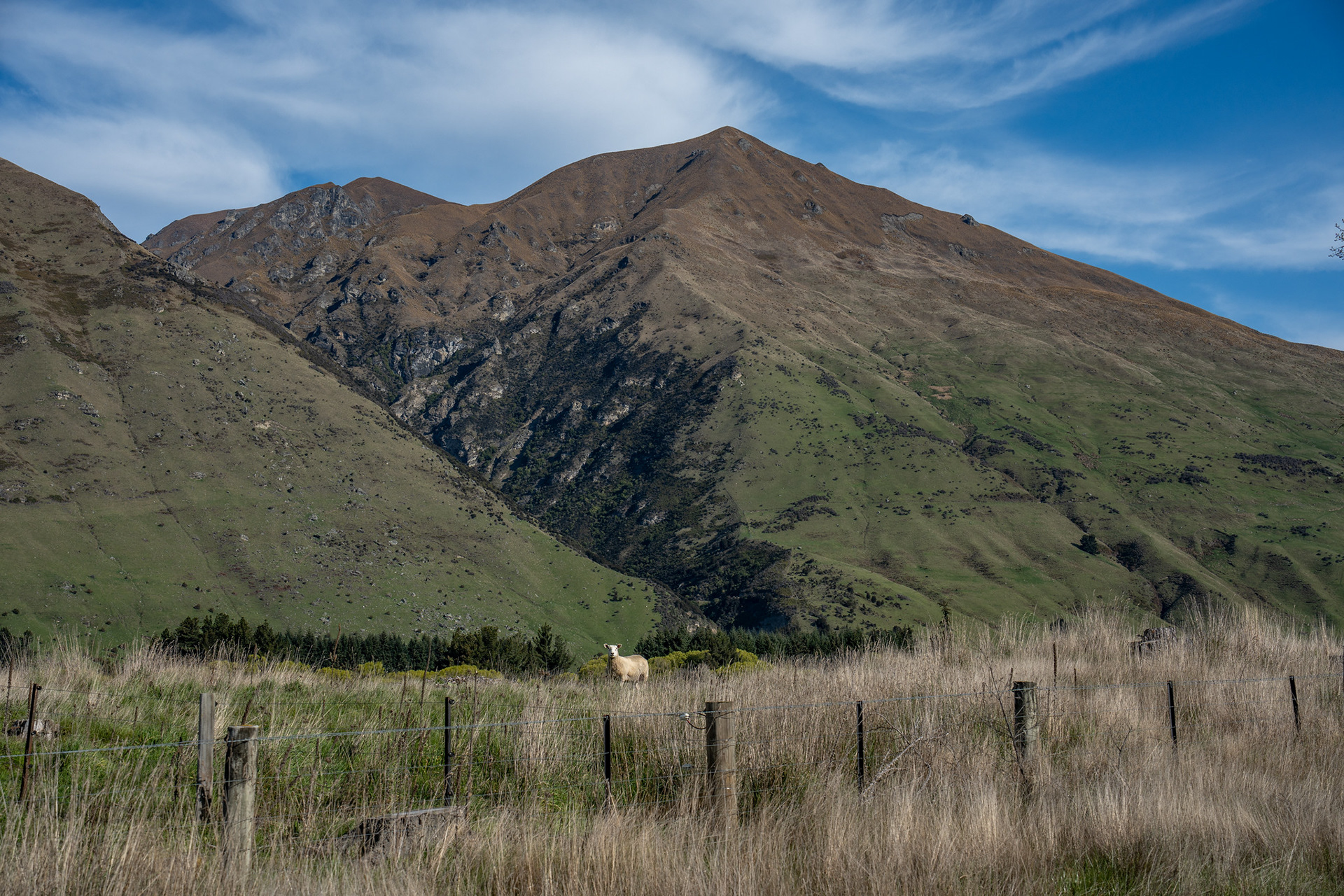
Admiring a guardian sheep.
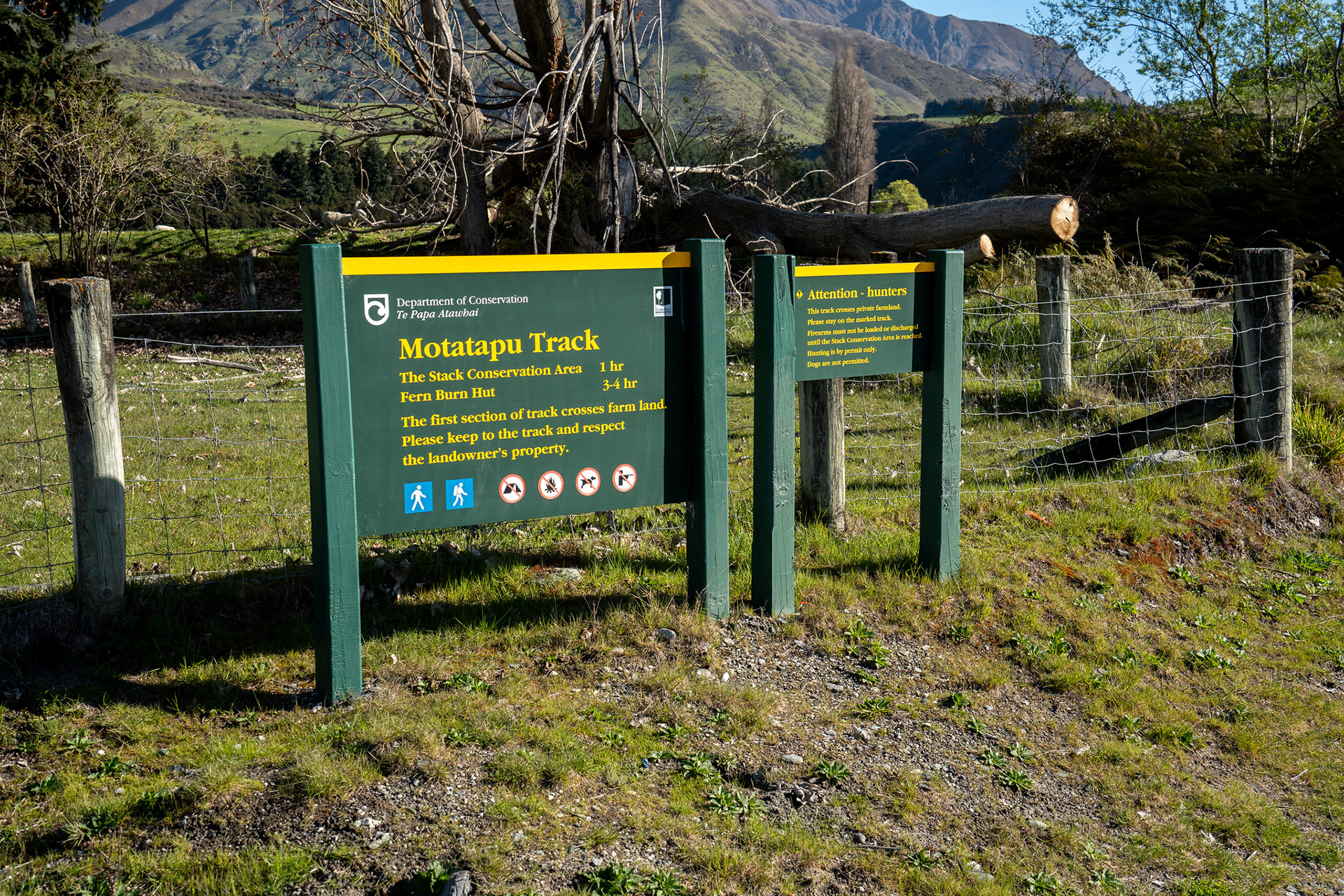
The DOC signage at the start of the track.
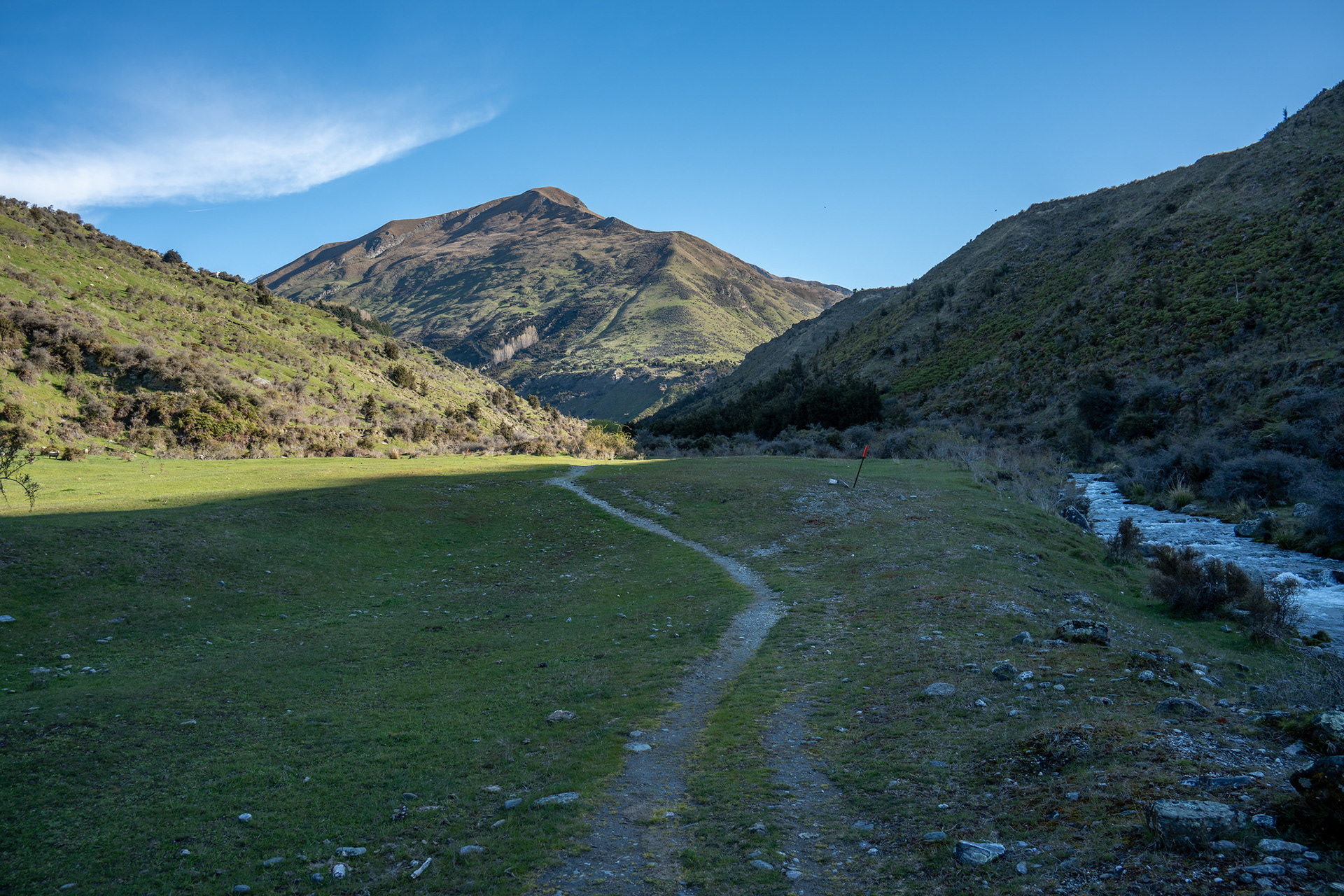
The initial few kilometres of the Motatapu Track follow pastoral margins, reasonably flat and often quite boggy. It feels like classic high country, smatterings of sheep for company and stock gates to traverse. It also feels utilitarian rather than inspiring, but it's only for a few kilometres until you hit the Stack Conservation Area and bits of beech. At the time of writing, part of the track on the true right has slipped into the river and can't really be sidled. In normal flows however, you can just wade the stream for a bit or do a delicate log traverse upstream and a dismount onto a boulder to keep your feet dry.

The initial pastoral sections of the track up Fern Burn.
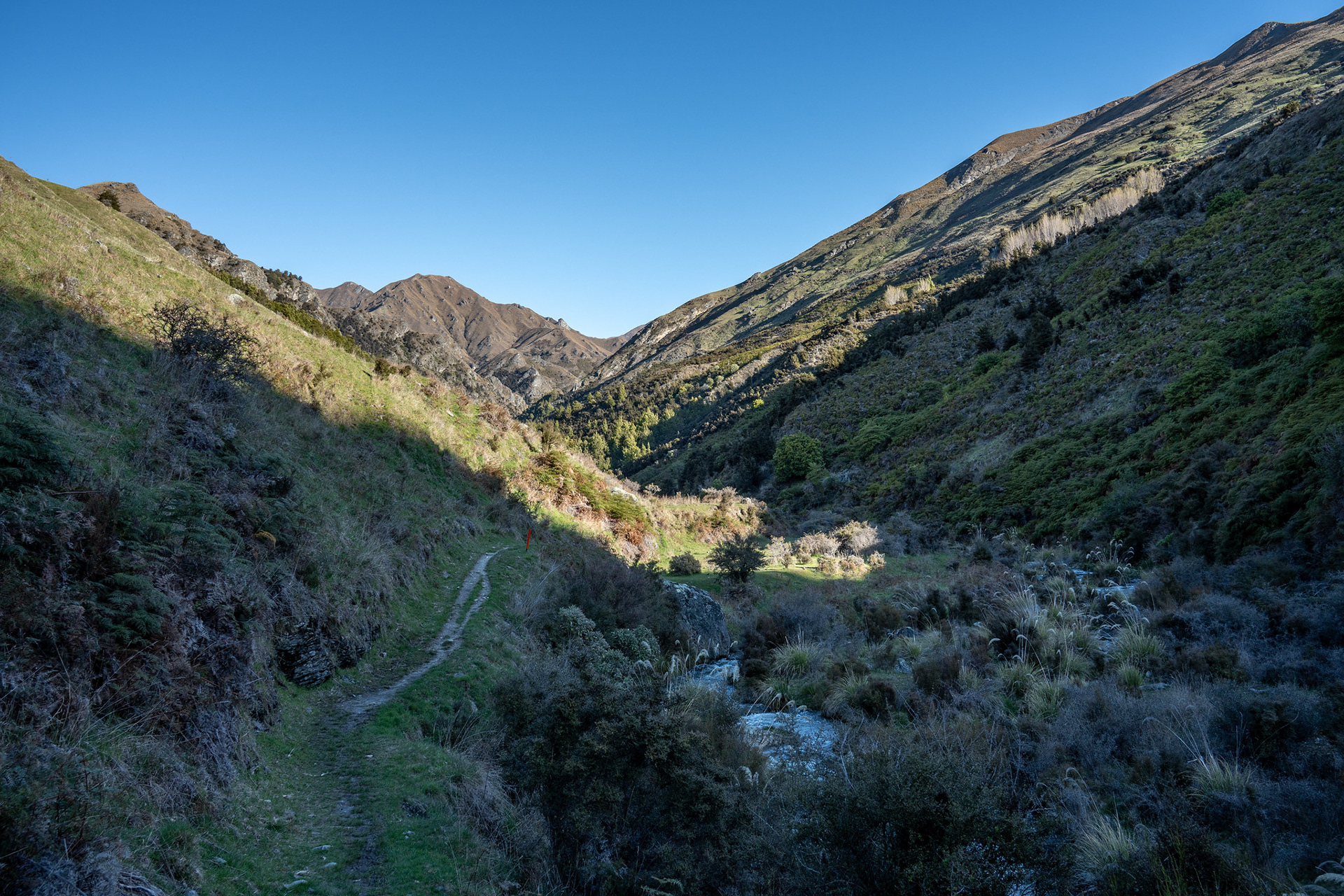
Still on the farmland, but starting to feel a bit more remote.
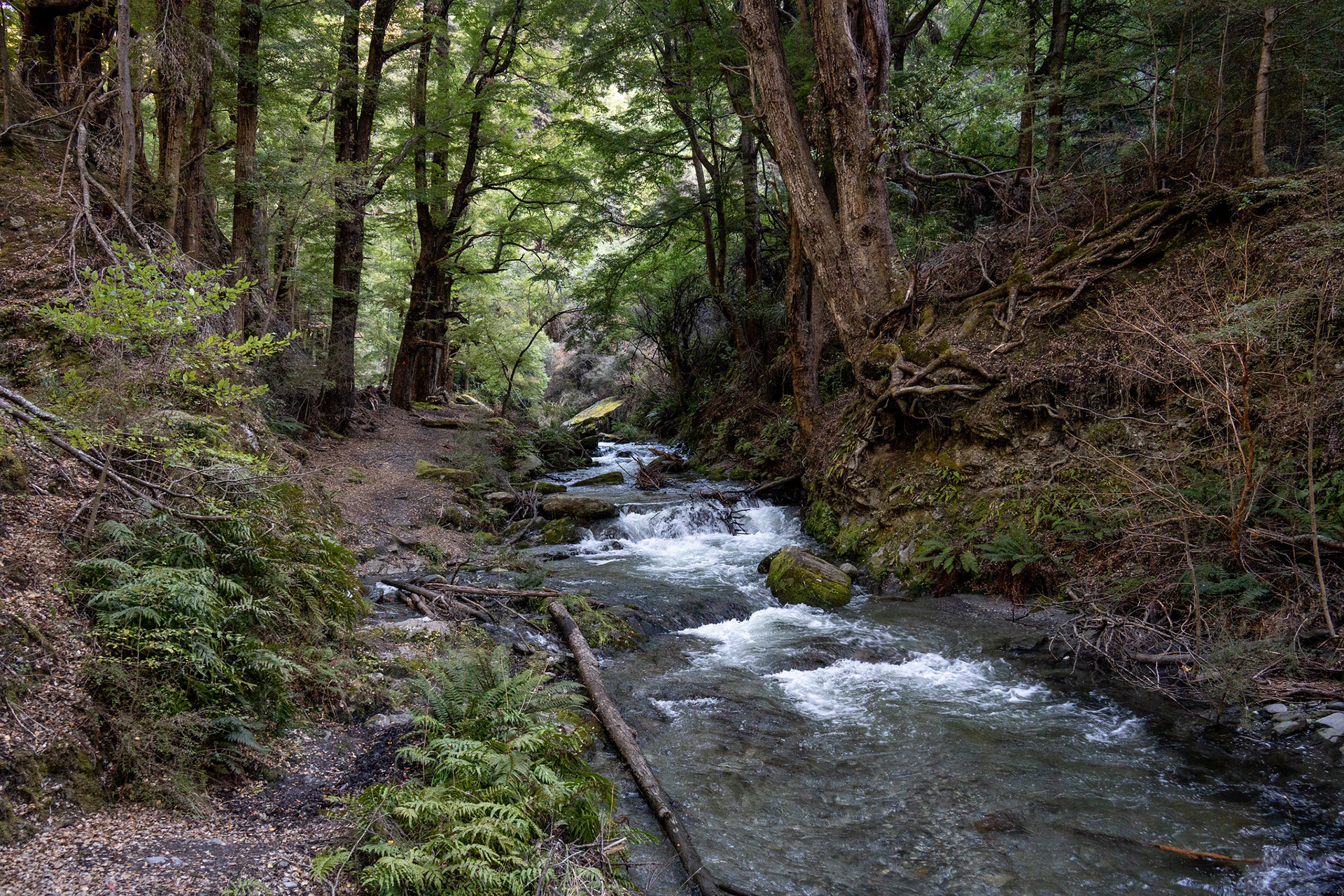
Passing into the Stack Conservation Area, with a little bit of canopy for a change.
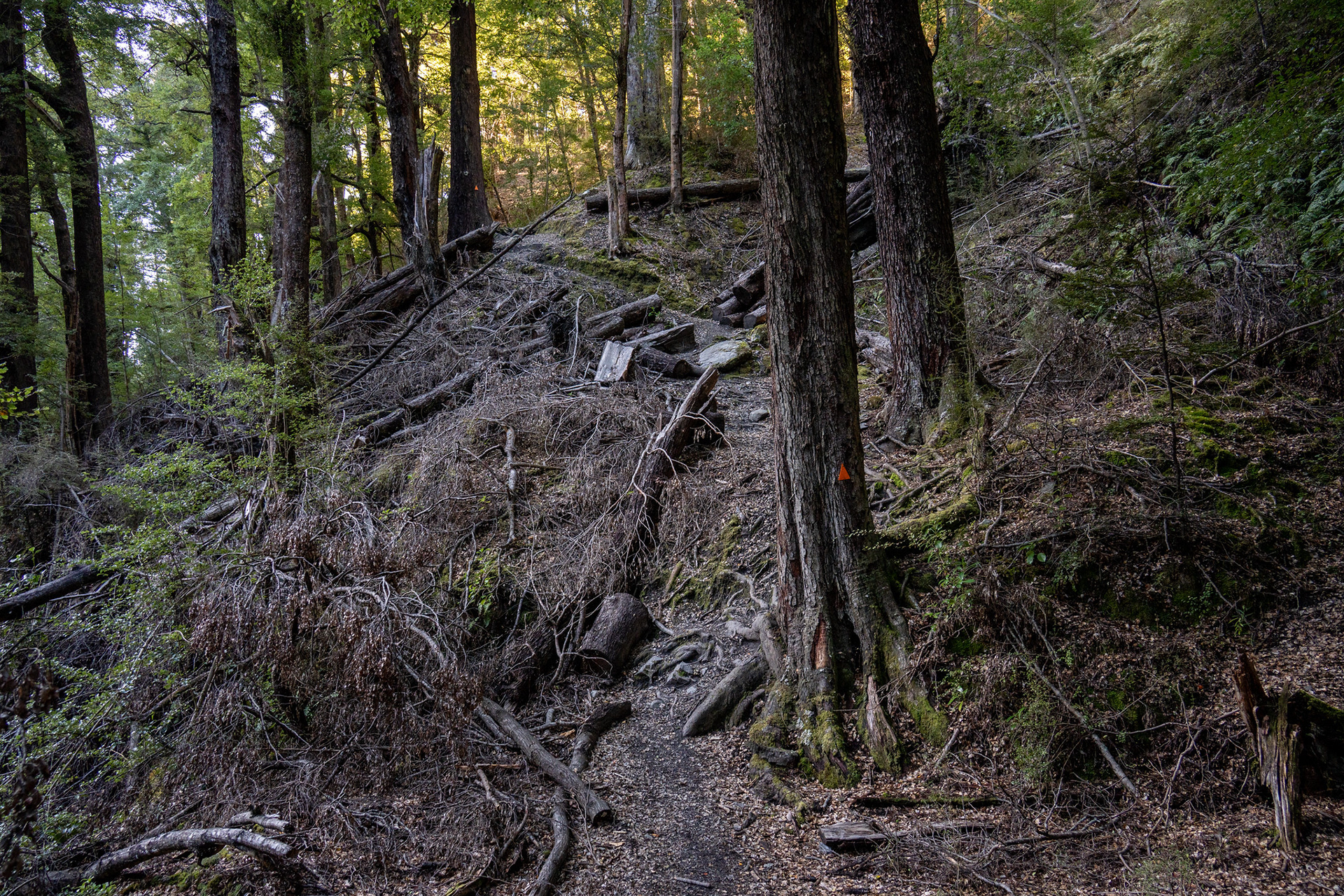
There are some ups and downs on the track to get around riverside obstacles.
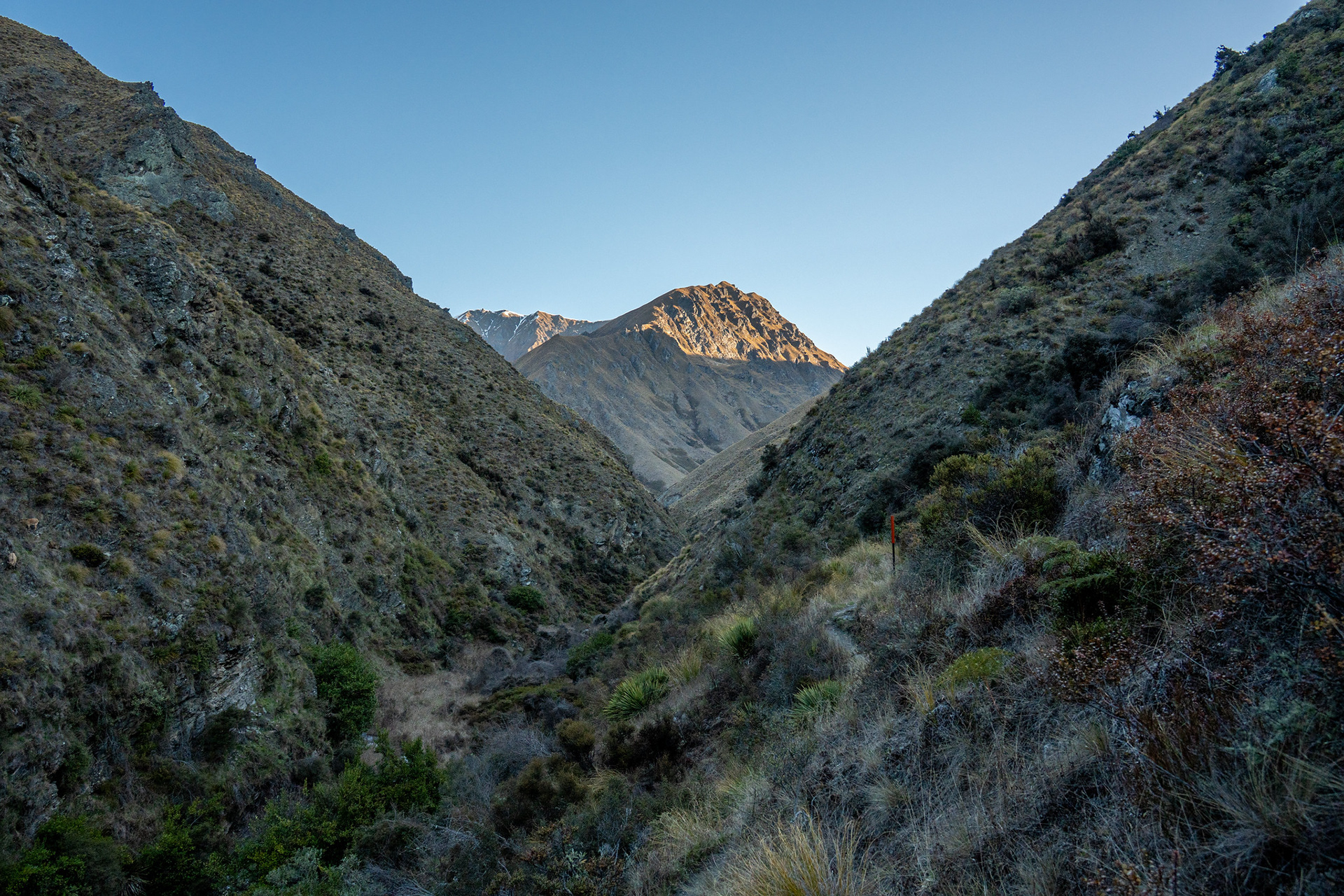
Fern Burn itself is actually bridged, despite not being shown on the topo maps. The tracked section on the true left is less gentle, lots of awkward ups and downs amongst rooty forest before further tussock is reached. The upper valley is mostly gorged, which means more high sidling on tracks which are well formed but slightly exposed. A few hours after setting out though, Fern Burn Hut becomes visible in the distance. By the time I'd reached the hut, my watch showed 26km and 750m of climbing for the day - the Motatapu component was roughly 7.5km and 300m.

Into the upper sections of Fern Burn, lots of high sidling to avoid the steeper bits lower down.
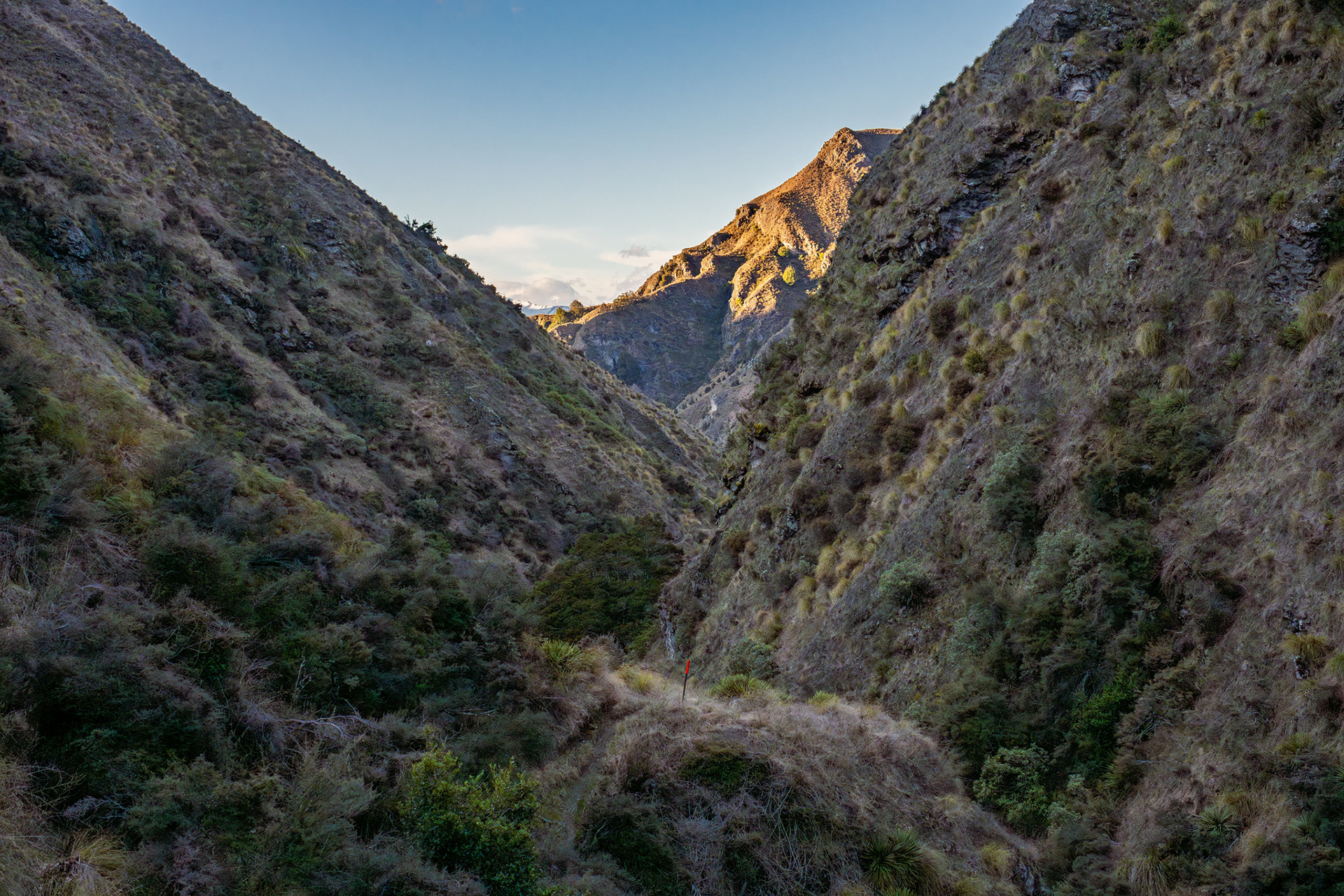
Back down the complex topography of Fern Burn.
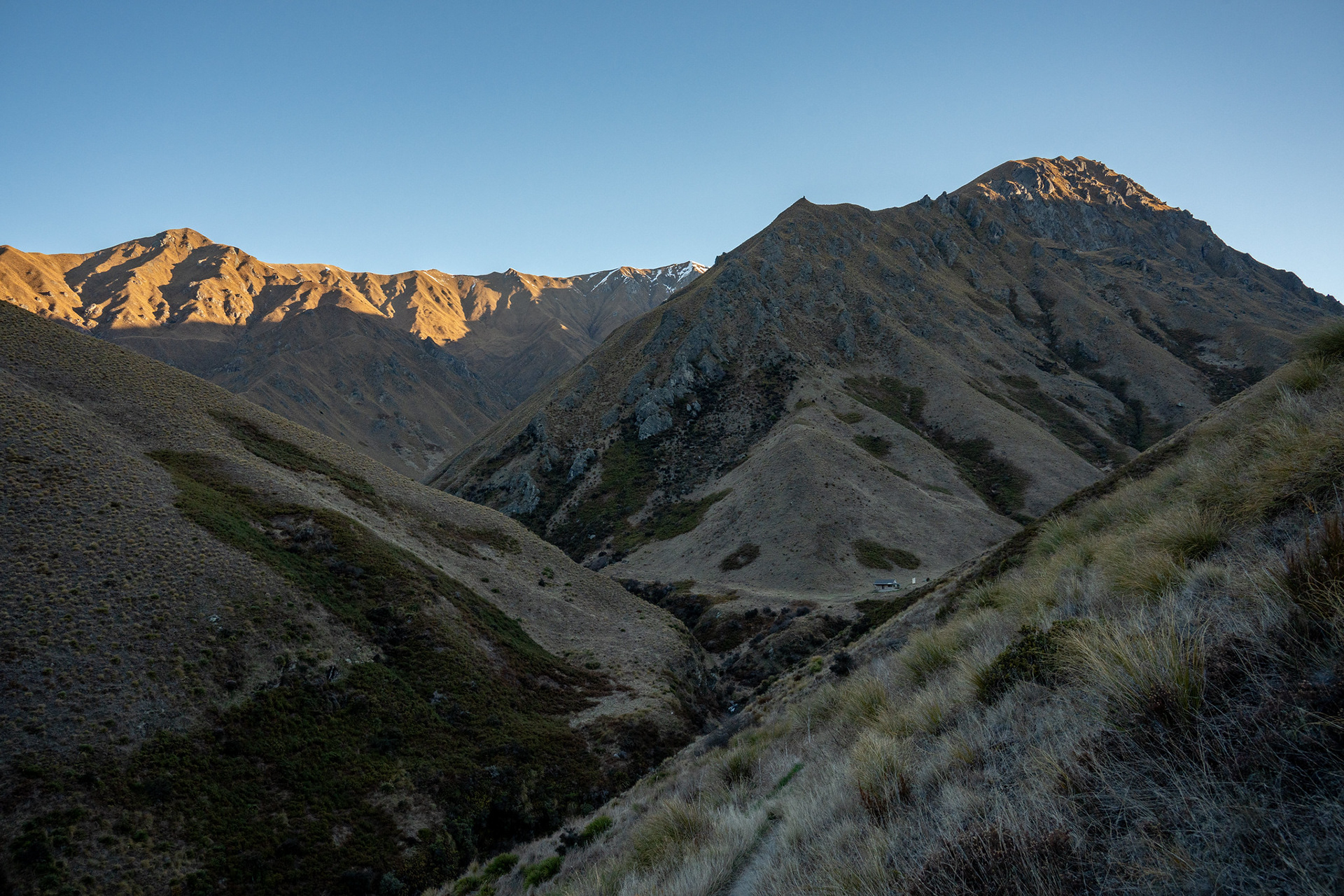
Fern Burn Hut coming into view.
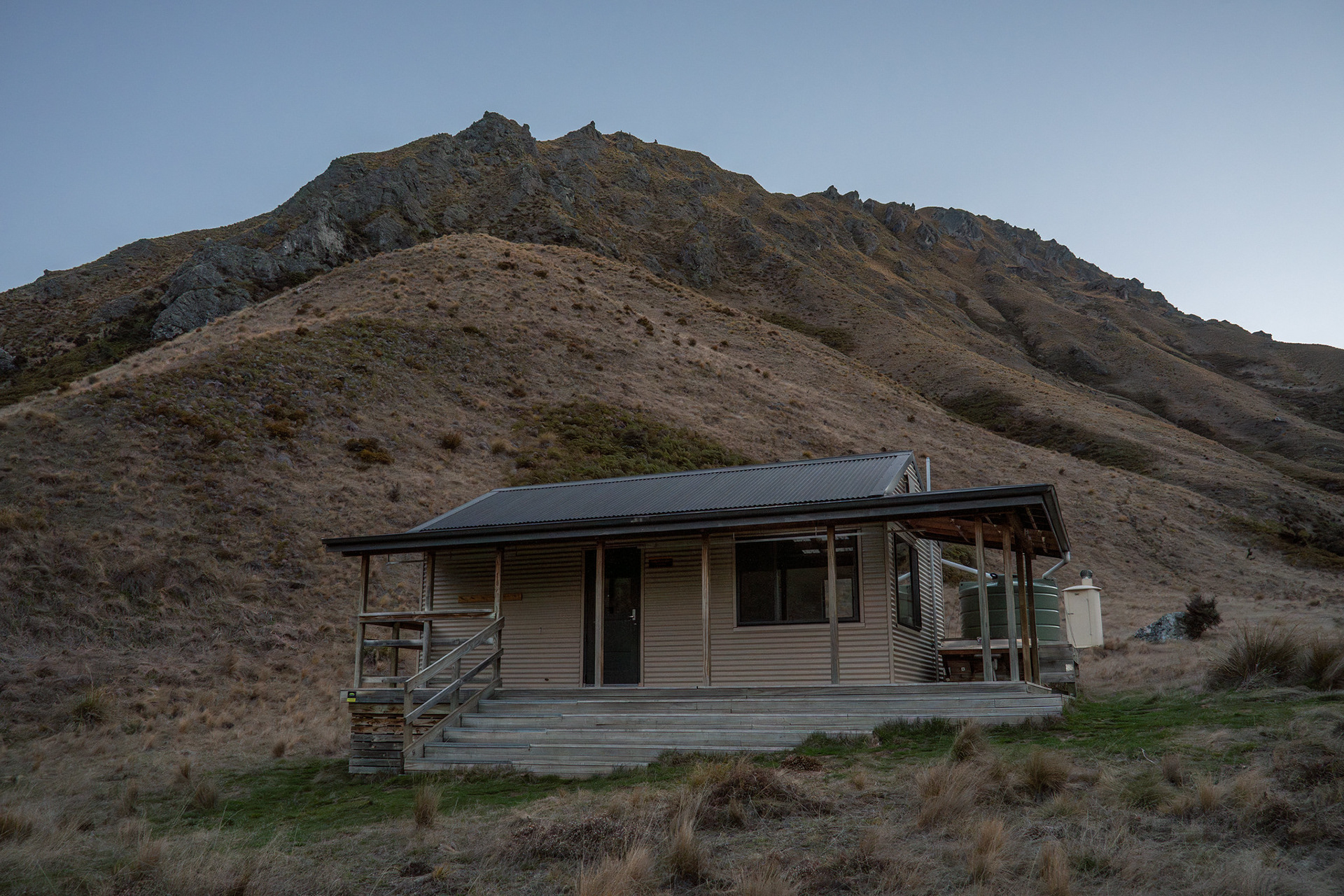
It was a bit of a relief to reach the hut pre-sunset, and I found it empty. A lot of folk who do Motatapu don't stay at Fern Burn, preferring to head all the way to Highland Creek on the first night. Provided you don't have to walk out to the track start, that's a very doable option - I took about 1.5h to Fern Burn and a further 2h up to Highland Creek, DOC times sum to about 7h. The elevation profile on those legs is also pretty moderate, Fern Burn to Highland is just over 700m of climbing and 6km. Some people do Fern Burn Hut as an overnight destination in itself, a cheeky out and back for a night away.
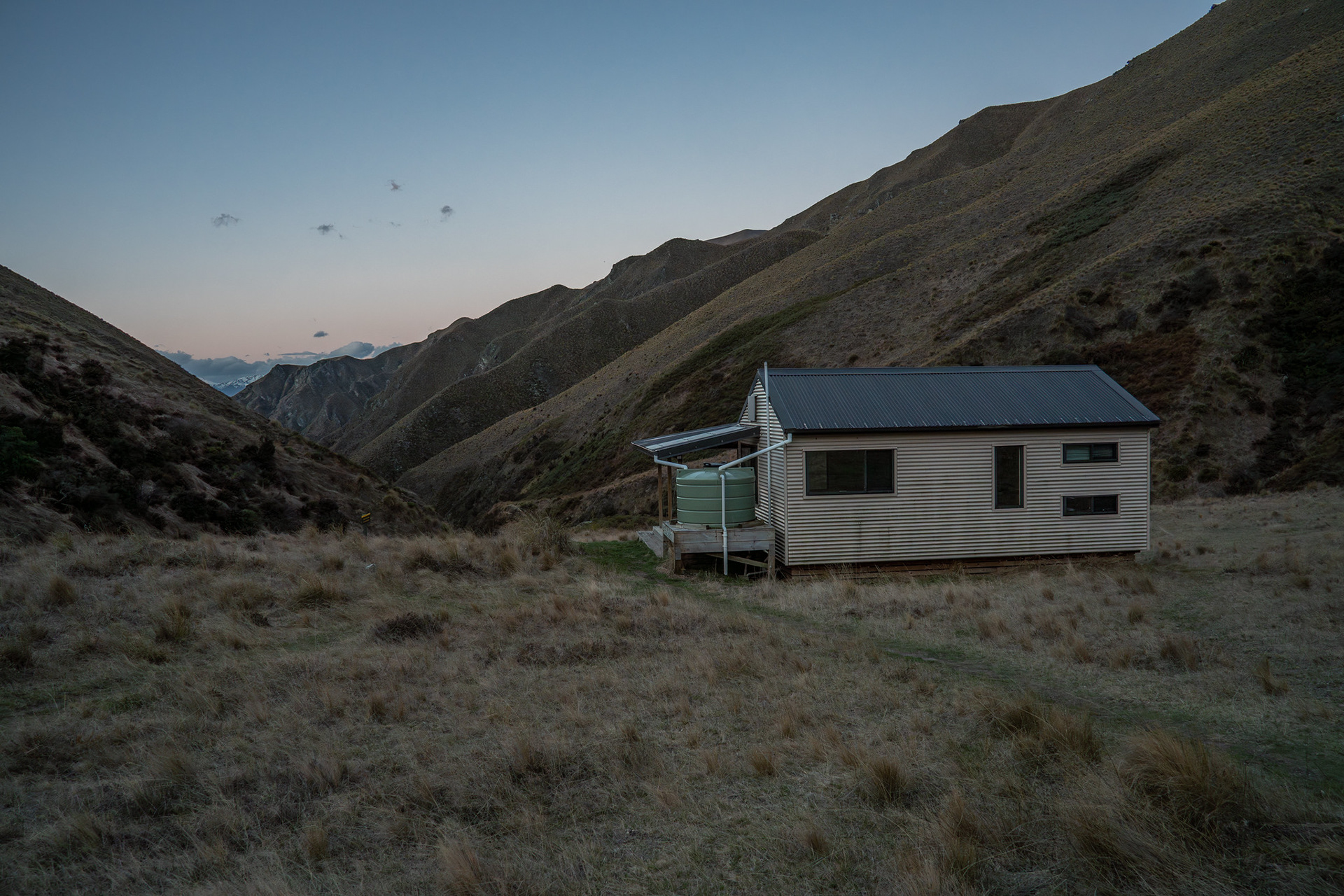
From the hut, there's a nice view down Fern Burn and the distant peaks bordering Lake Wanaka. You might get very marginal cellphone reception, though it's not something to rely on. The hut sleeps 12 and is unheated, though plenty warm enough in October. It has a toilet nearby, and currently a lot of possums.

Fern Burn Hut in the evening light.

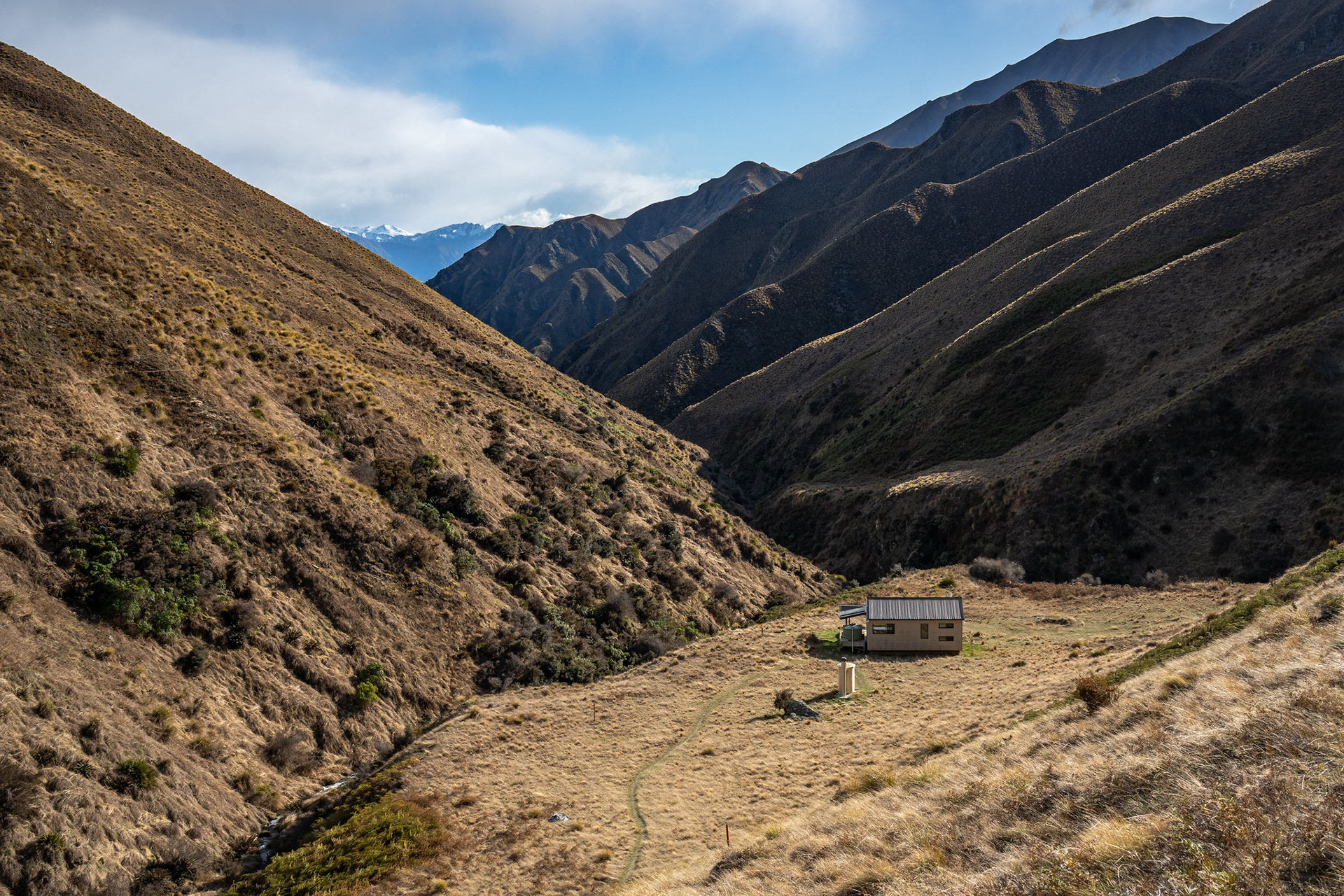
Fern Burn Hut and the view down Fern Burn itself.
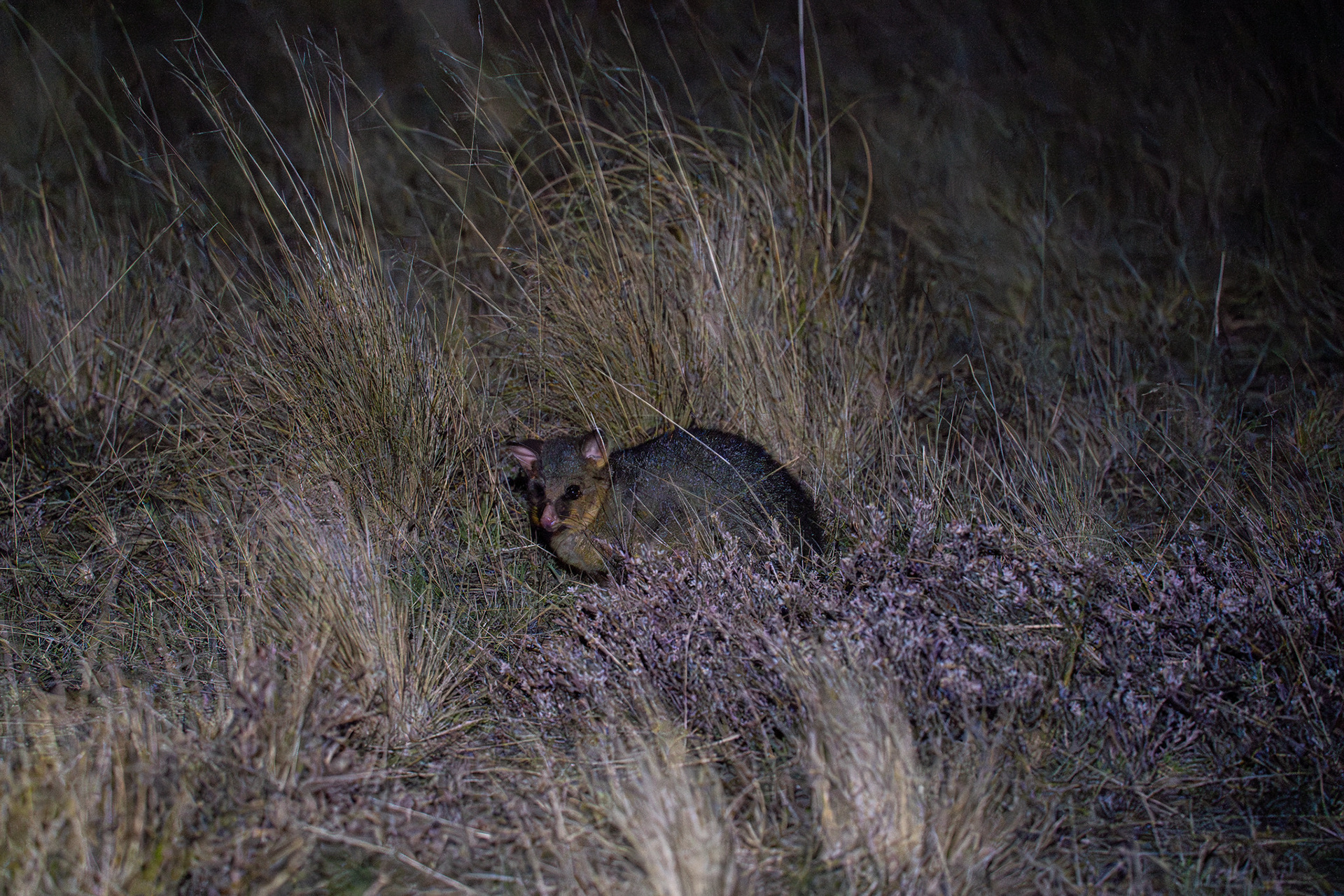
One of the night visitors.
After a slightly broken sleep, I lazed and somehow didn't get going until a bit after 9:00am. I always find trips where I fly down a bit disjointed, tending to overpack in the name of conservatism but then not having security-prohibited kit like gas cookers or tent pegs. I also tend to overbuy food, you might want three muesli bars a day but if they come in packs of six and you have three days... You can do the maths.

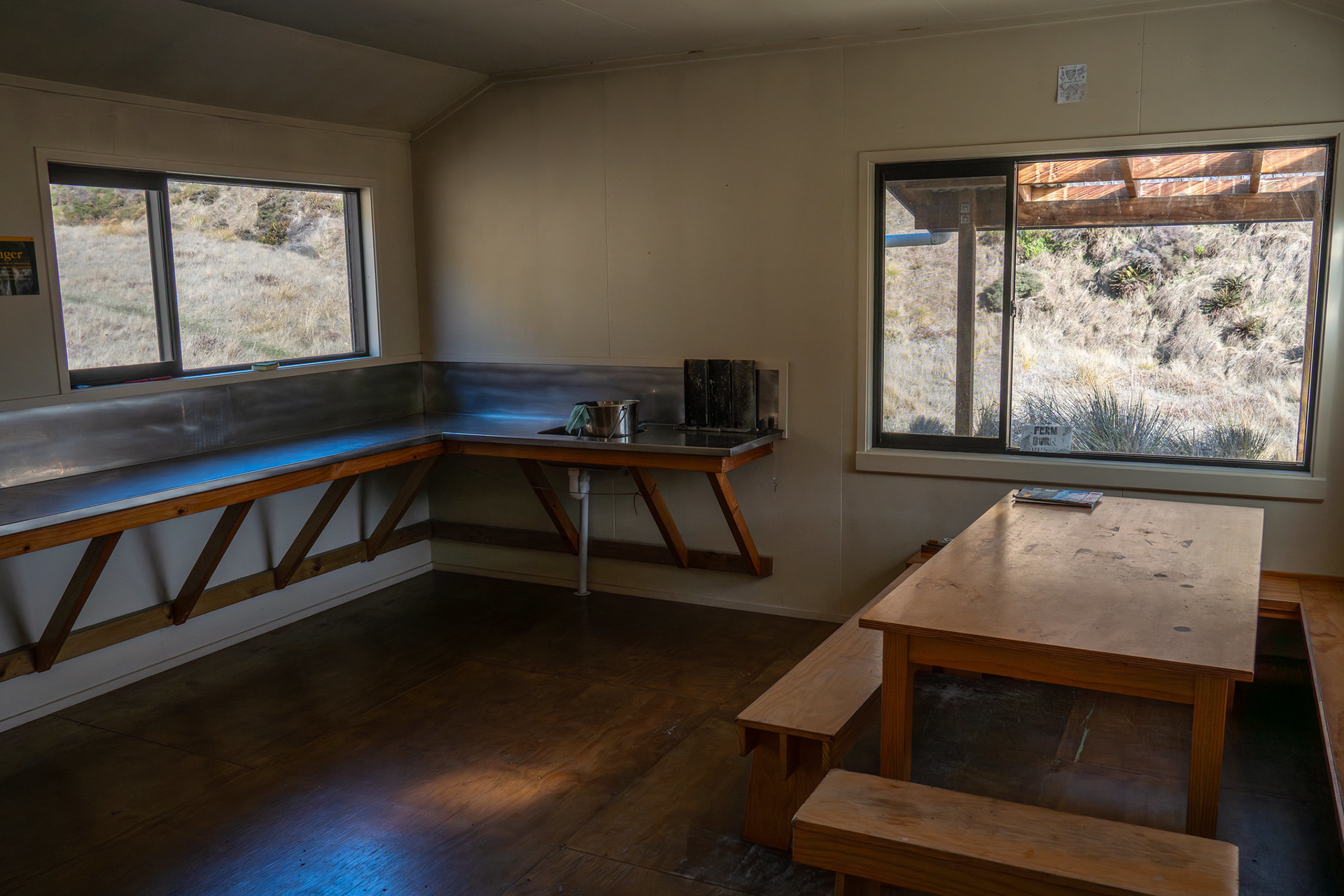
The communal area of Fern Burn Hut.
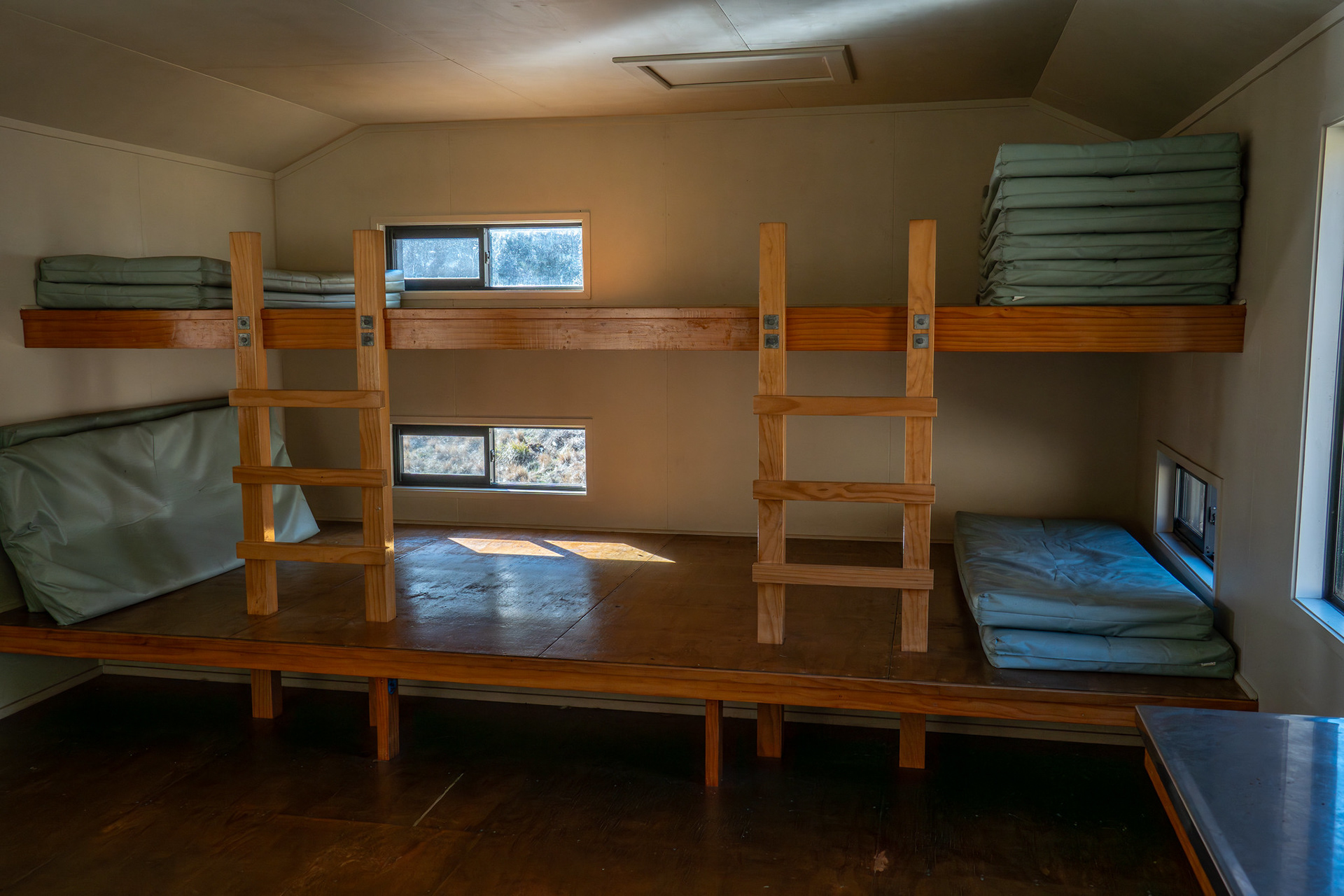
Bunk slats at Fern Burn Hut.
The first day had been a bit harder than expected. I think it was the pack weight, first night I'd had in a DOC hut for probably six months so carrying a 10 - 11kg pack was a bit foreign. The DOC timings for the second day were 4 - 5h / 6km to Highland Creek Hut and then another 7 - 8h / 11km to Roses Hut. It seemed like an imposing schedule, particularly when counting contours suggested it would easily be 1500m+ of climbing across the day.
Heading off from the hut, the route climbs immediately albeit gently. This branch of Fern Burn is somewhat gorged higher up too, so the route sidles on its true right with occasional ups and downs through side-spurs. On paper, it looked like a trivial-ish 500m or so of elevation gain to cross a ridge near a poorly defined saddle - this is informally 'Jack Hall's Saddle'. The route itself doesn't actually cross the saddle proper, as the far side has collapsed into a steep slip face which wouldn't be navigable.
There are nice views back on the climb, looking down on Fern Burn Hut on its small bench. There are also smatterings of views back into Lake Wanaka, and what would presumably be Aspiring country were it not such poor weather in the alps. There are bits and pieces of cellphone reception as you go, the last reception for a number of hours (and for the day if you're overnighting at Highland Creek Hut). I had the interesting phenomenon of blue skies above and steady rain, as the precipitation from clouds many kilometres to the NW was blasted near-horizontally to my locale.

Looking back down on the hut at the start of Day 2.
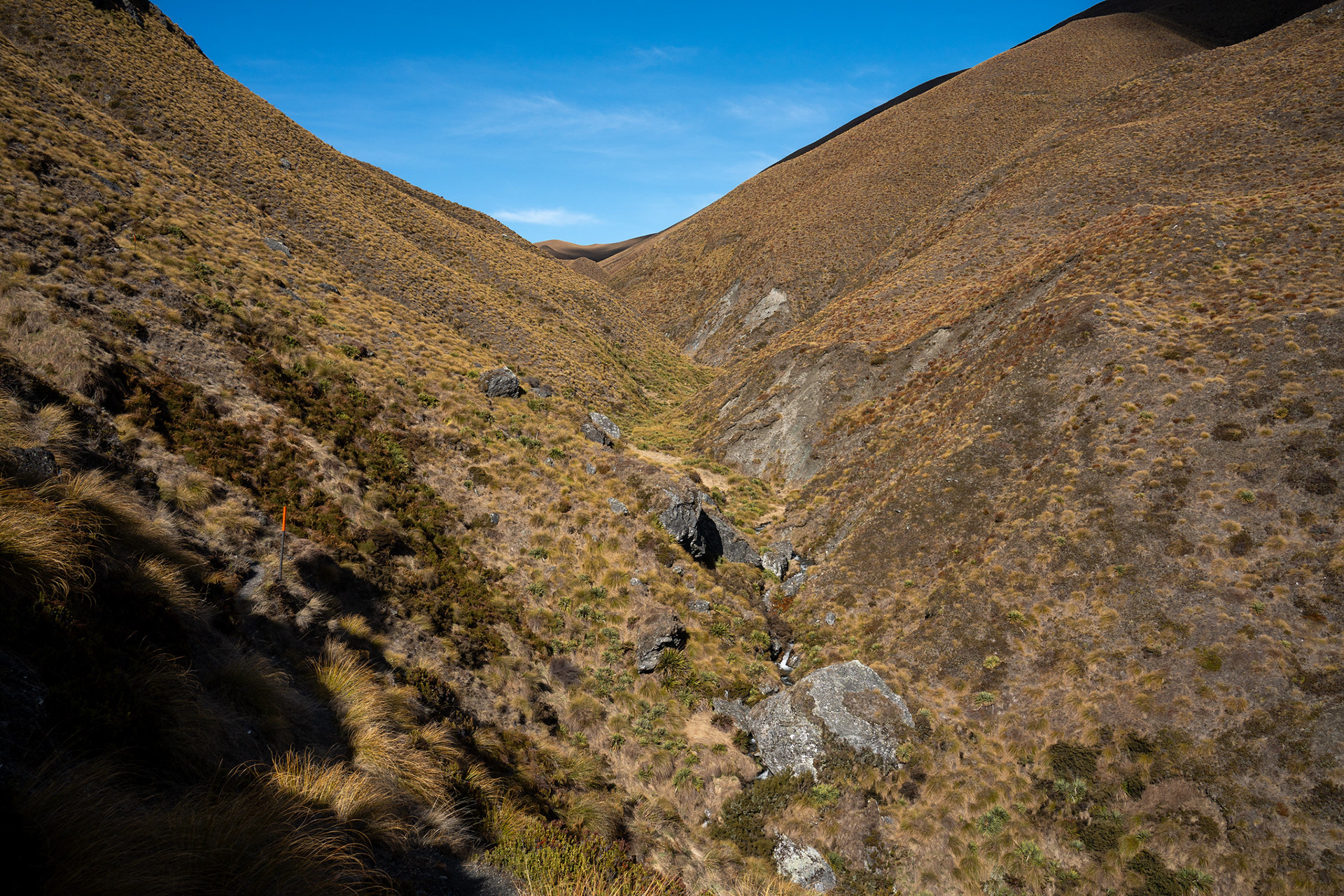
A view up towards Jack Hall's Saddle in the far distance.
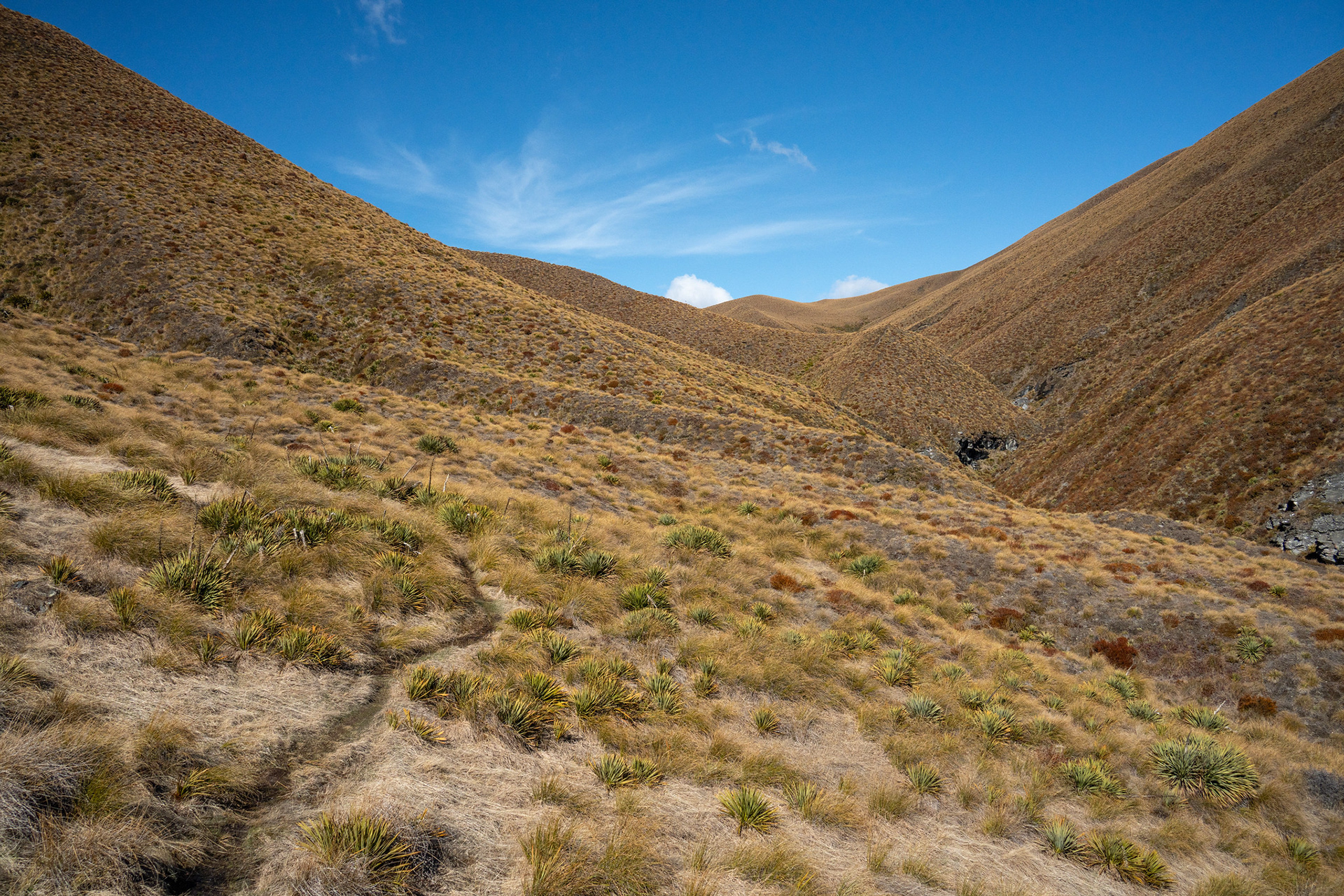
As the saddle is approached, there's a short drop down before commencing the final face climb. There are many skinks in this area, I encountered hundreds in this section which was a nice taste of the wildlife. The owners of the station undertake pest control and have vested a lot of the stations in QEII covenants, so hopefully this will provide long-term ecological benefits in the area.

Easier ground now, the saddle getting a bit closer.
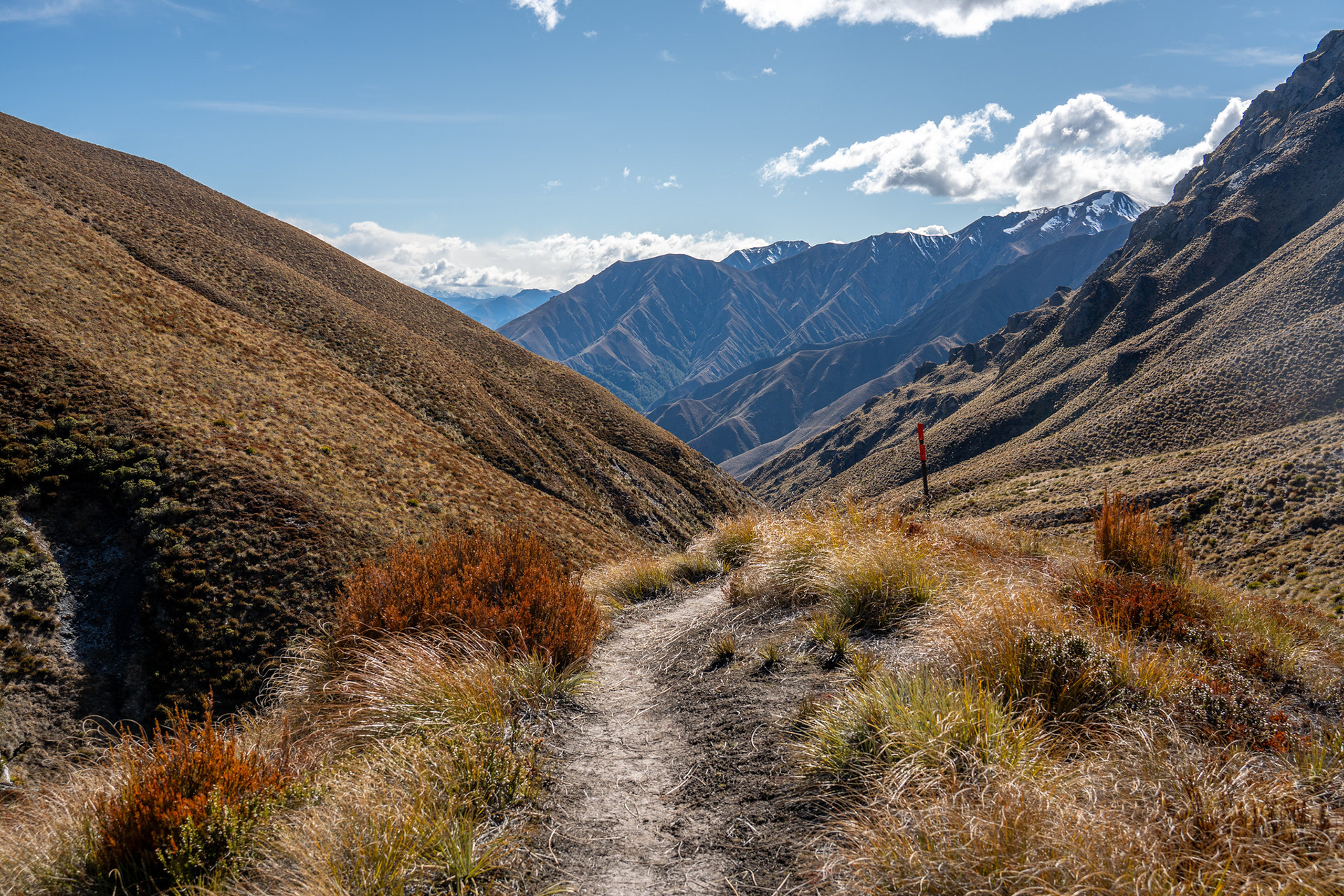
A view back from near the saddle.
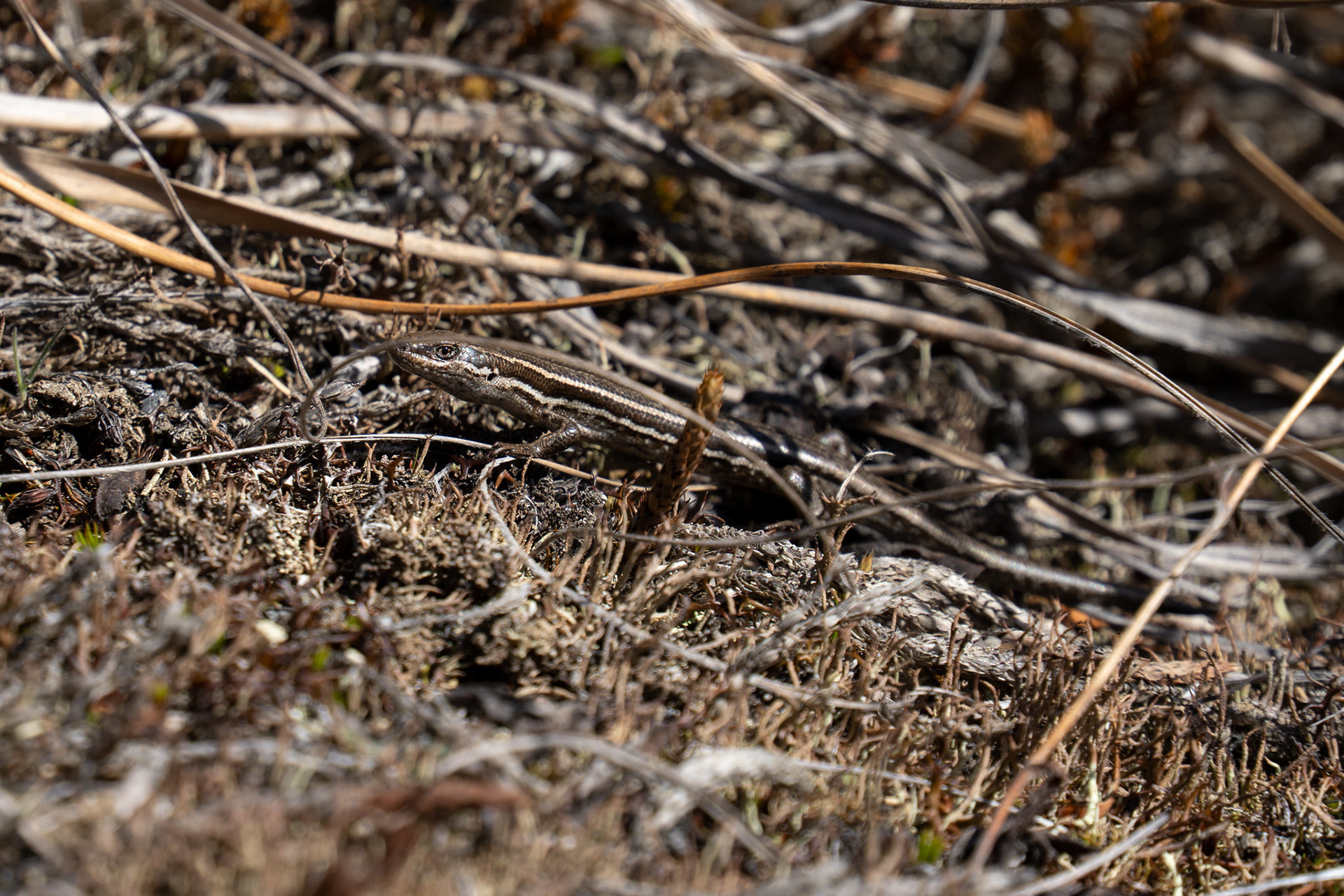
One of the resident skinks.
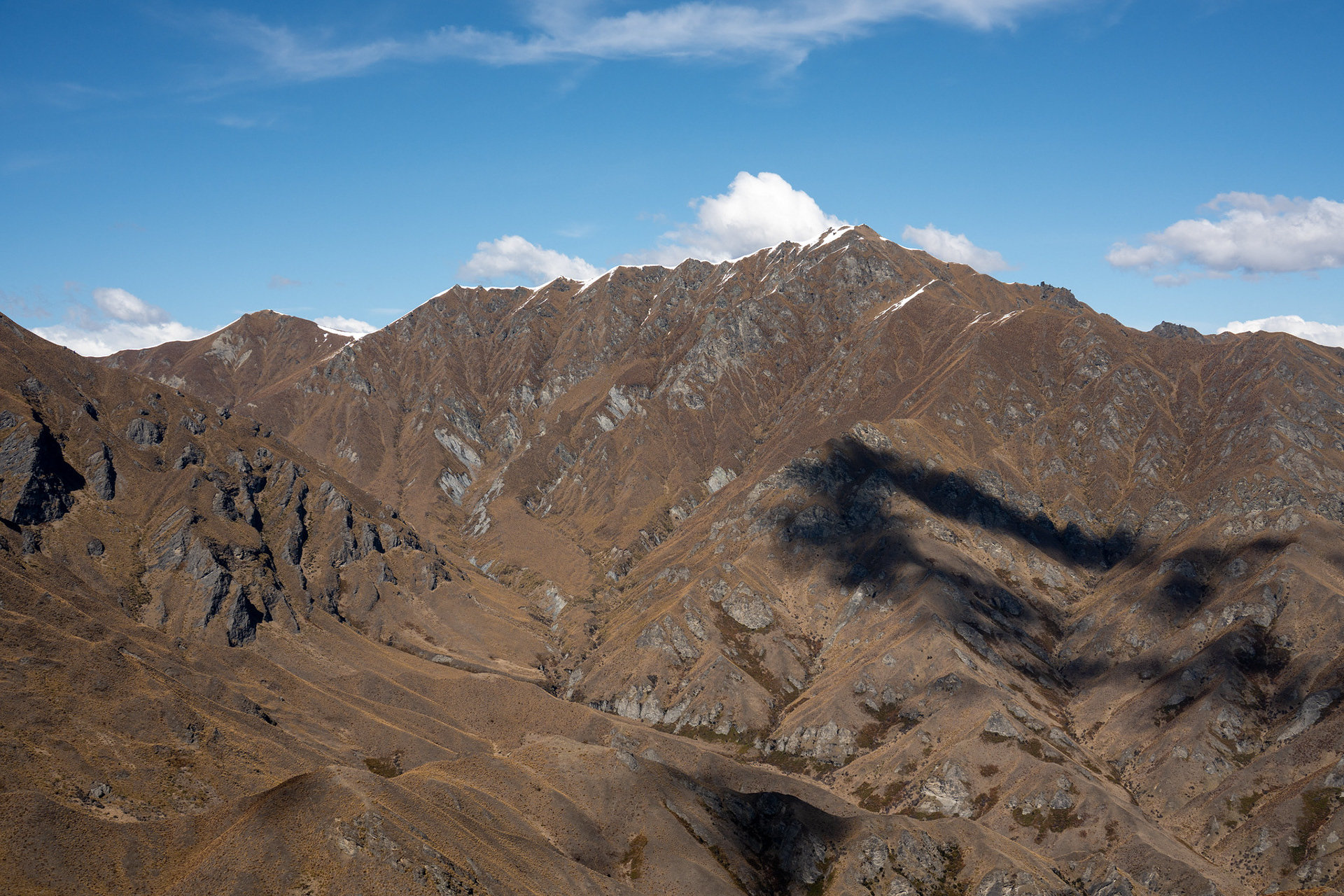
Reaching the saddle provides a break from the climbing, and a mixture of views. Motatapu is a bit of an interesting one view wise, as almost all the vistas you encounter are easily visible from civilisation - the high peaks on the true-left of the Motatapu Valley are prominent from Glendhu Bay, as are the Aspiring peaks. The southern hills are not readily visible from Arrowtown, but you can drive to the base of Coronet Peak and then gondola up to effectively the high point which provides a grand vista into the upper Arrow catchment. You could probably argue that the northern faces of Knuckle Peak are a bit unique, but I imagine there are spots on the Wanaka Mt Aspiring Road which also have line of sight.

A view of Knuckle Peak and its litany of radiating spurs.
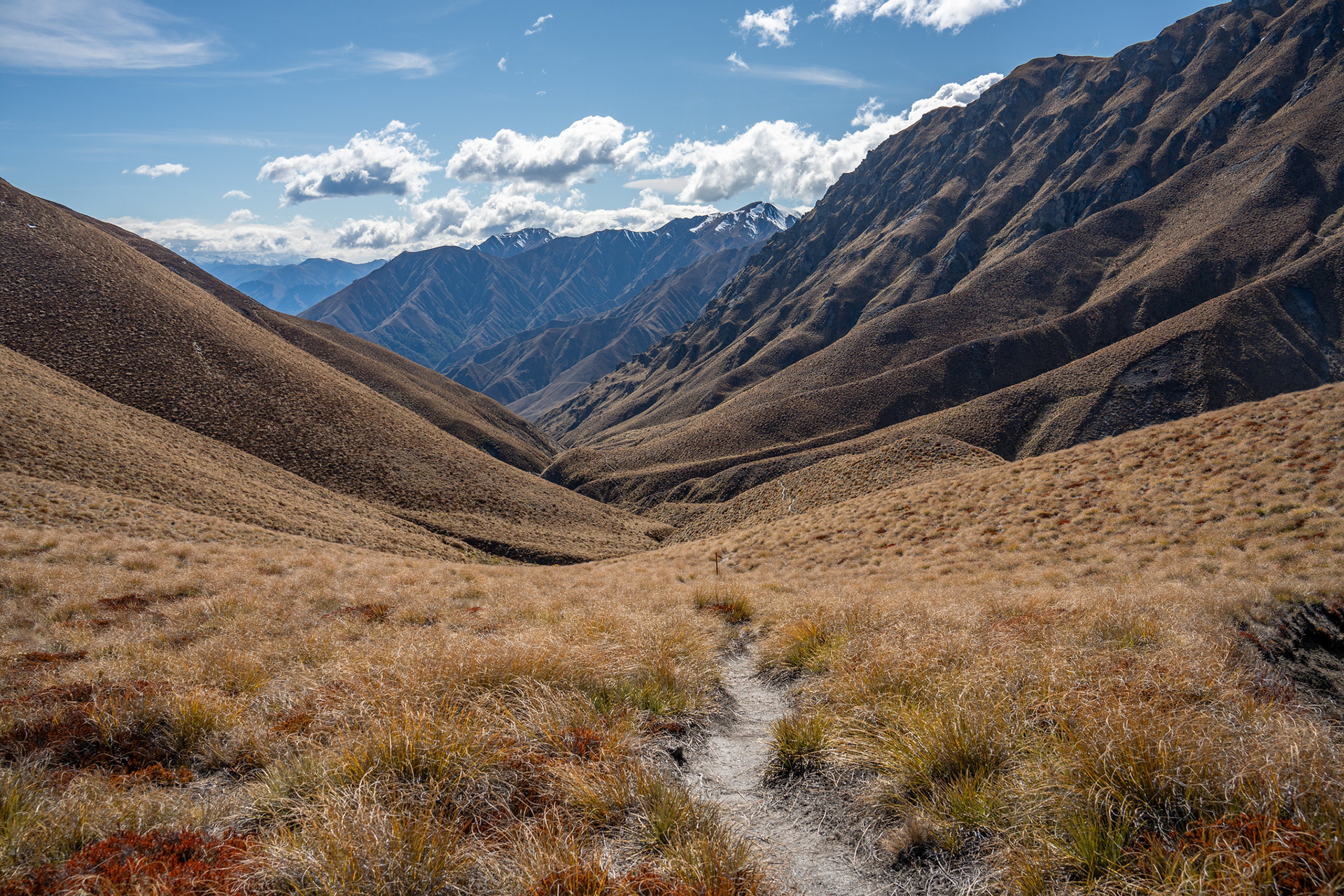
Back down Fern Burn as I leave the catchment.
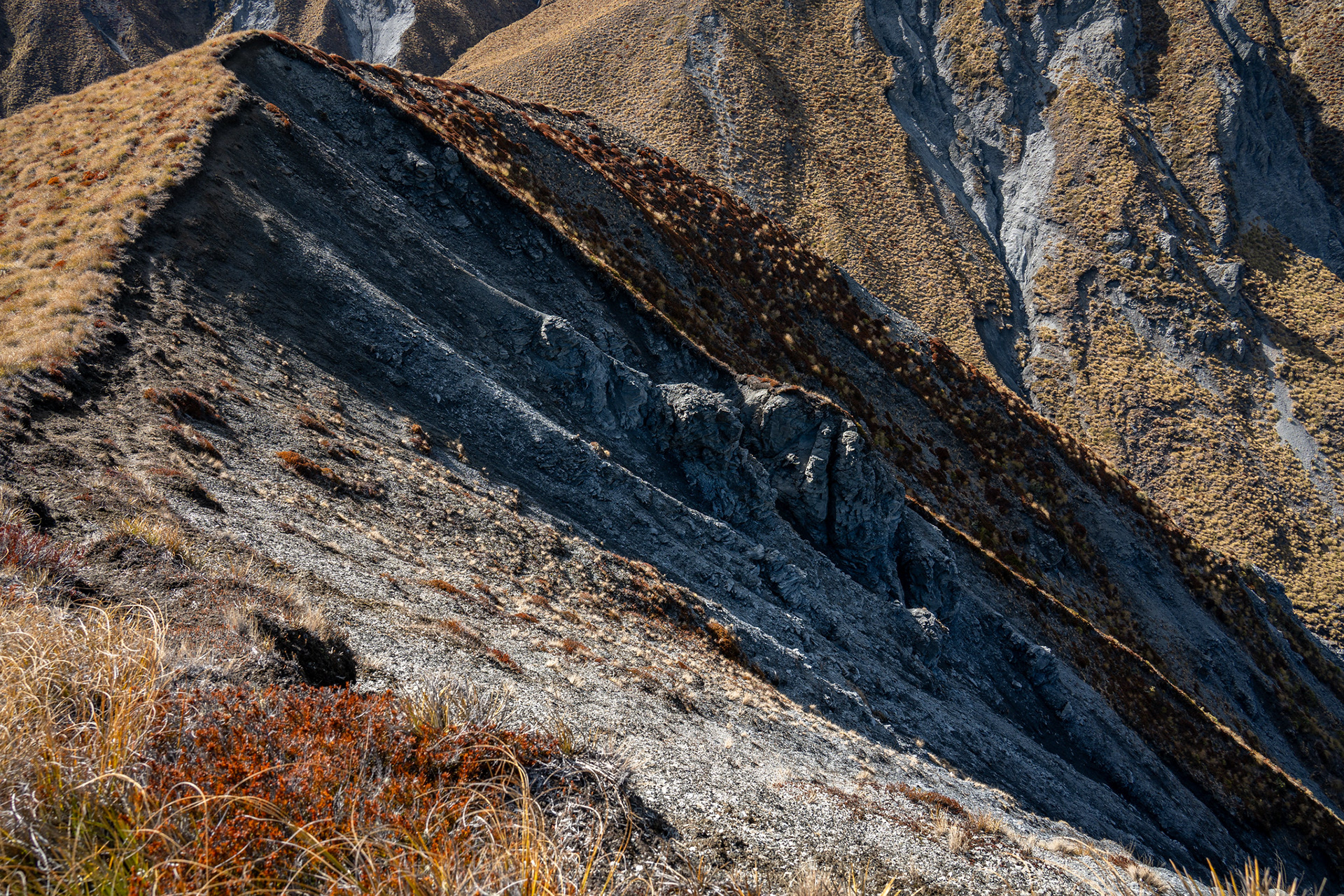
The slip on the other side of the saddle which prohibits the lower crossing.
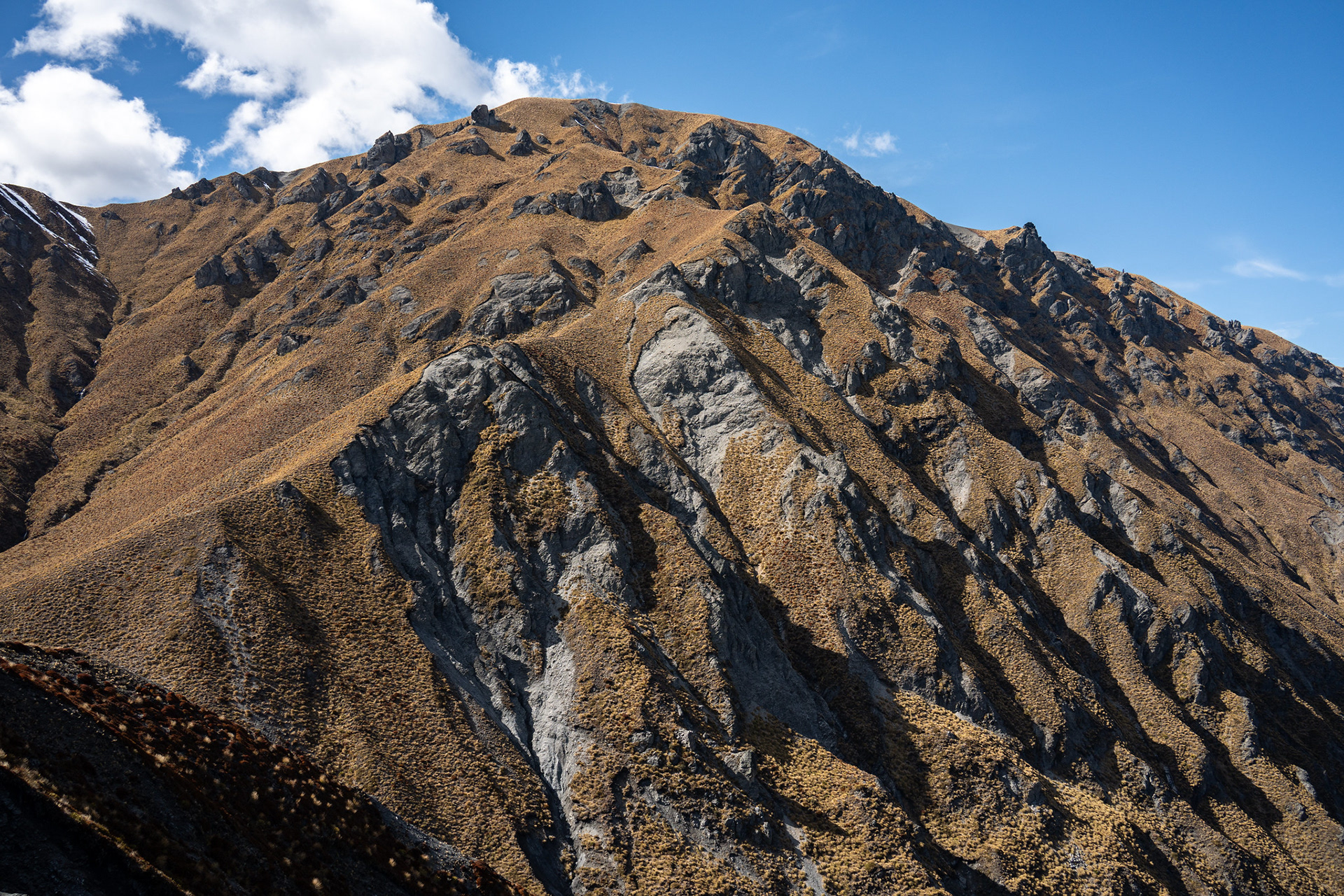
A view up to the bounding ridge, interesting rockwork.
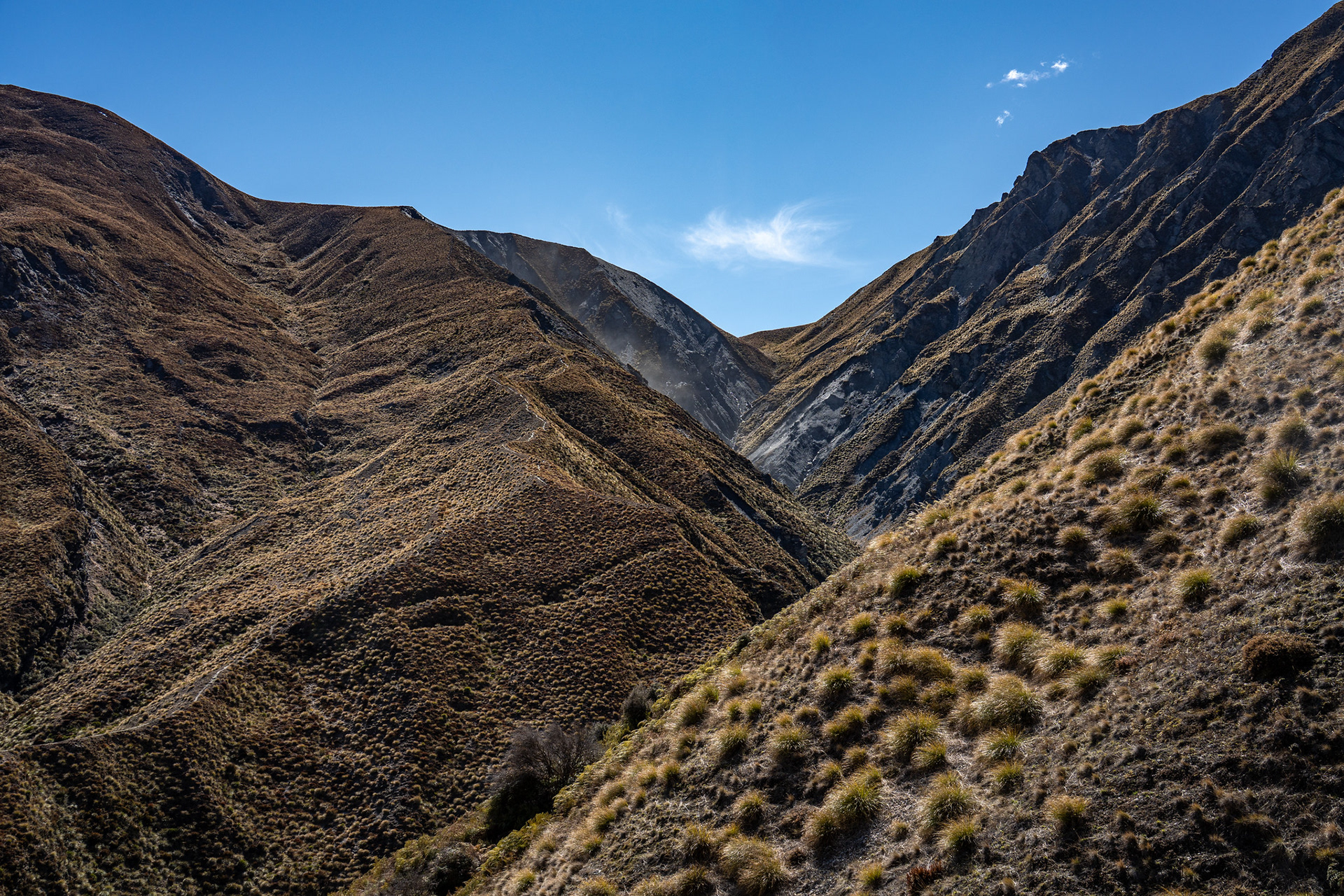
Anyway, I digress. From the saddle, it's an initially steep drop down a spur which borders the slip face before some flatter terrain below. At this point, the wind was positively howling and I had to remove my hat - probably need another Mole Map now. At the base of the spur, a section of river flat is visible. I hadn't really scrutinised the map and was hopeful the track would contour around the lower side-spurs, but it was not to be. It was to be another one of Motatapu's recurring themes - a reclimb.

Looking back up to the saddle, with the track visible centre left.
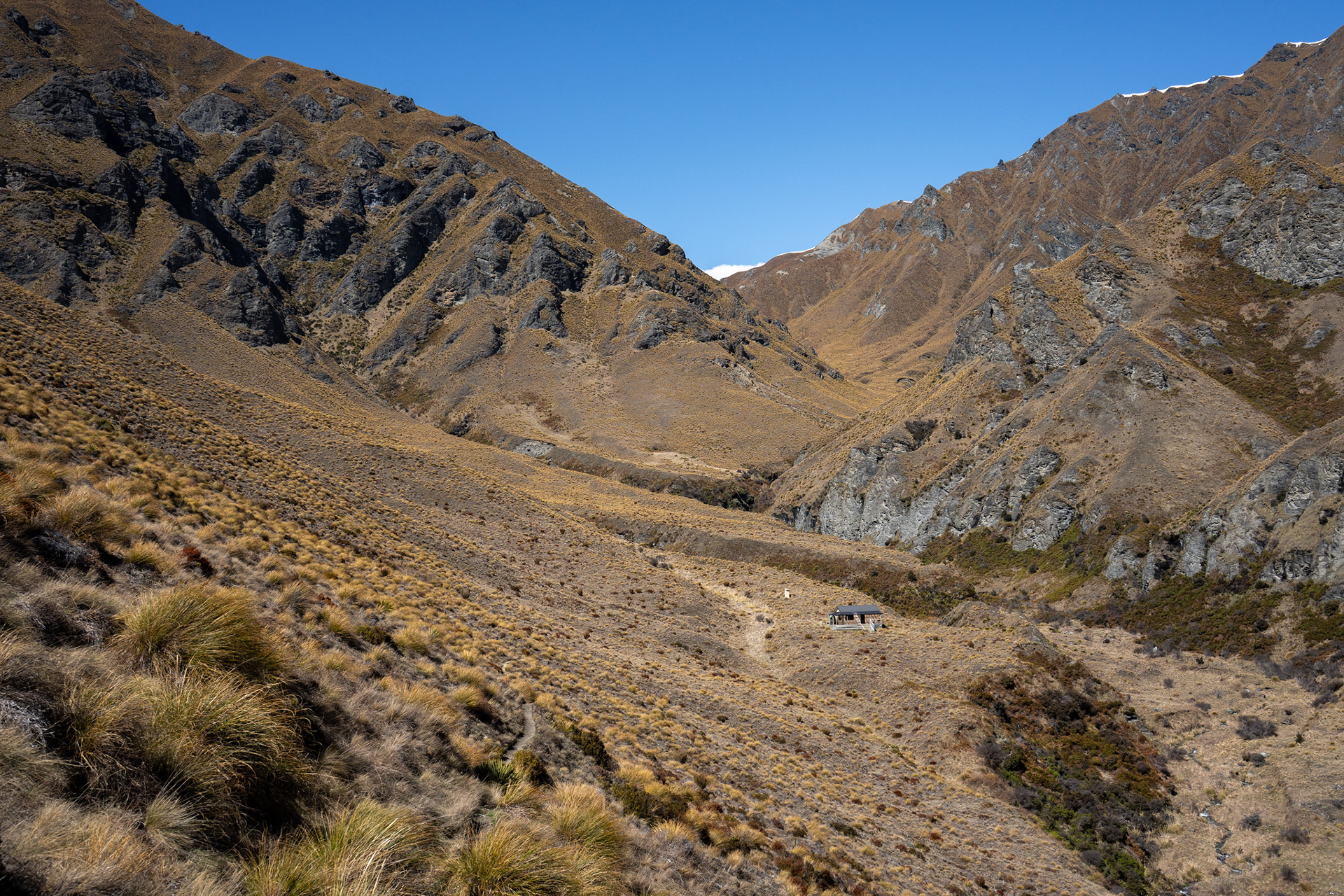
I don't mind reclimbs, in theory. If you have to cut across a gully, shedding 10m of elevation to meet the apex at a good crossing point is a small price to pay. This was not such an effort, climbing about 150m onto higher tussock slopes before the sidling recommenced. I mean, I get it - the lower faces were steeper, the spurs more pronounced, it wouldn't be an easy trackline to build. Psychologically, it's difficult though knowing that there was still over 1000m of climbing to come beyond Highland Creek Hut.
At the top of the climb as the descending resumed, there were a few moments of concern when I almost got blown off the ridge and onto the faces below. Fortunately that ridge travel was short-lived, and I was back lee of the wind and back to serenity. Another 15 minutes of sidling brought me to Highland Creek Hut, and a rest break.

Dropping to Highland Creek Hut.

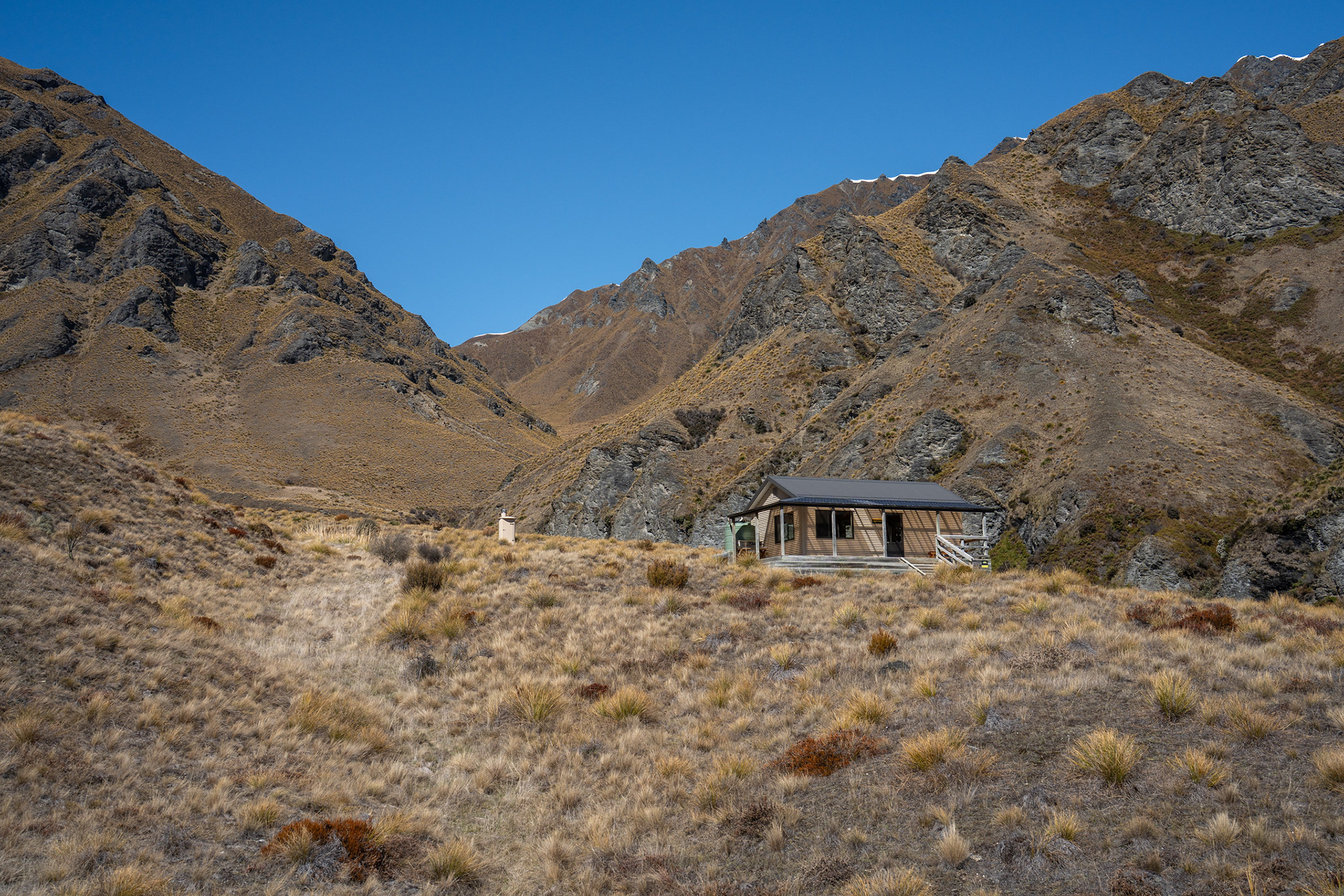
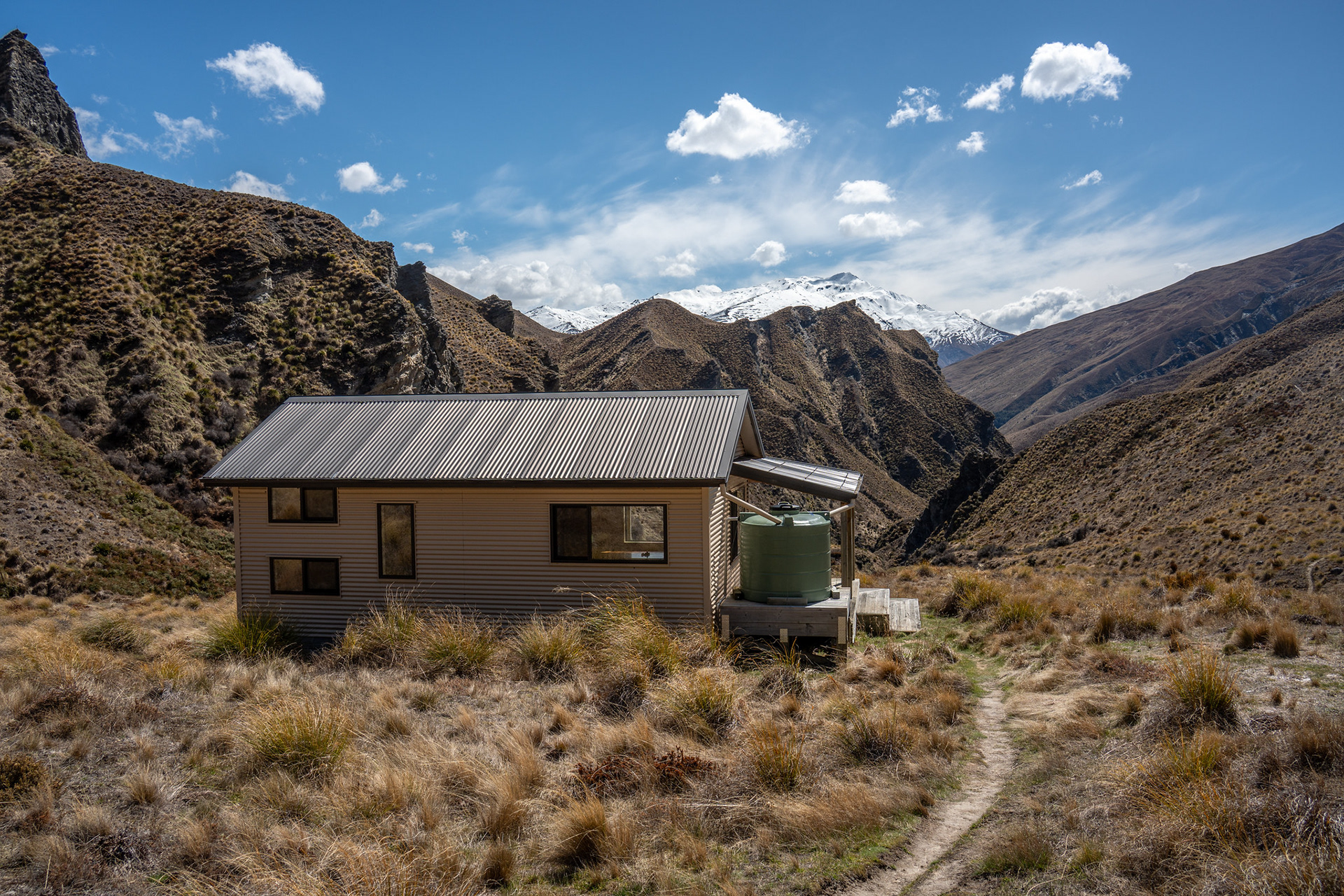
All three huts on Motatapu are nearly identical, beyond their locales. Highland Creek Hut is a nice setting, backing onto some rock-studded ridged with some lumpy tussock spurs framing a downvalley view to the Motatapu flats. It sleeps twelve, has a toilet and a water tank.
I had somehow gone through almost 2L of water in the 2h of travel, so that was recharged and lunch was had. Sitting in the hut is a bit of a disconcerting experience in high winds, as the polycarbonate deck awning is not strongly affixed and the shaking produces a sound similar to torrential rain. The hut does seem structurally sound though, and has survived intact for almost 20 years so far.

Highland Creek Hut in its basin.

The view with its awkward topography beyond, End Peak in the distance.
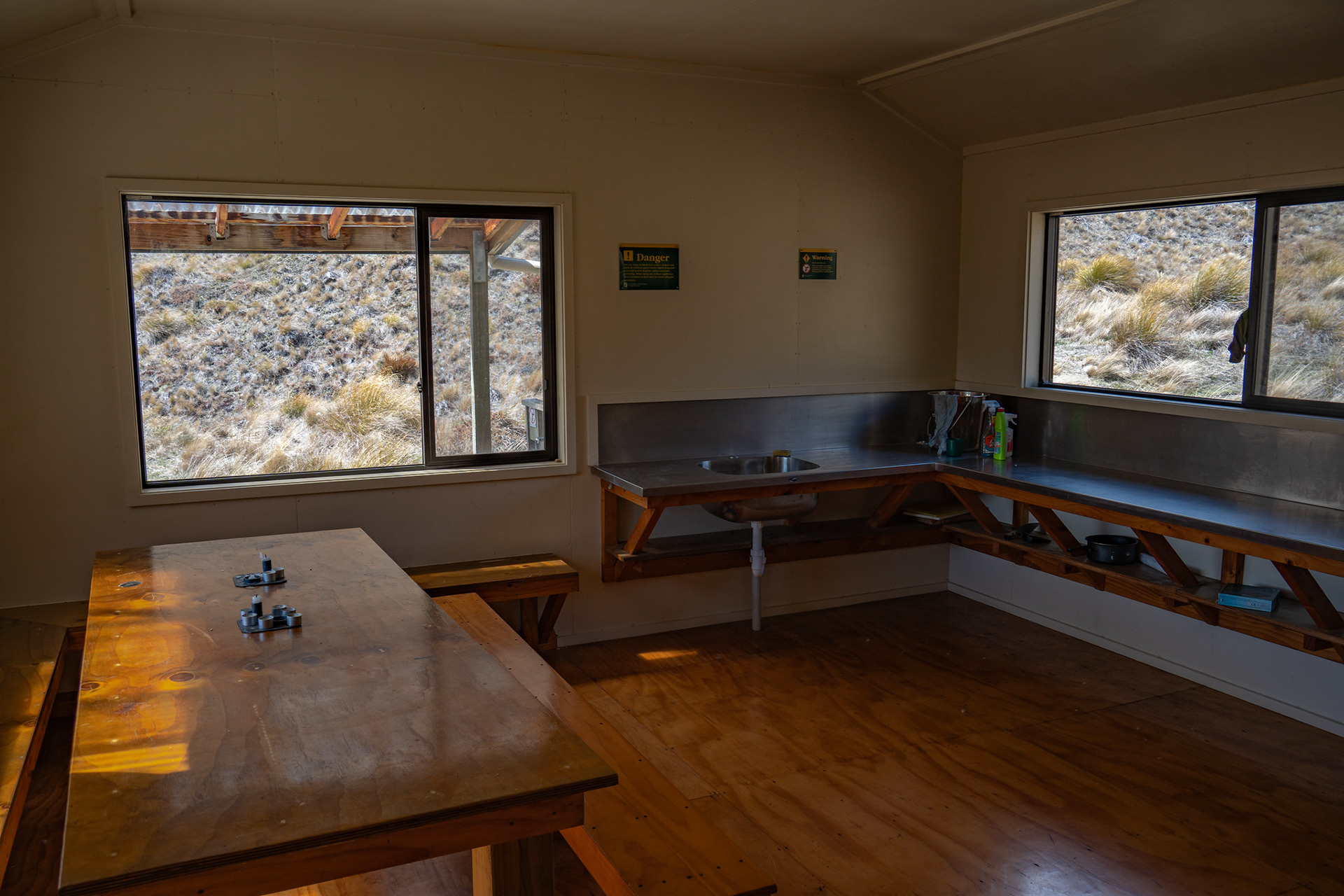
Communal area of Highland Creek Hut.
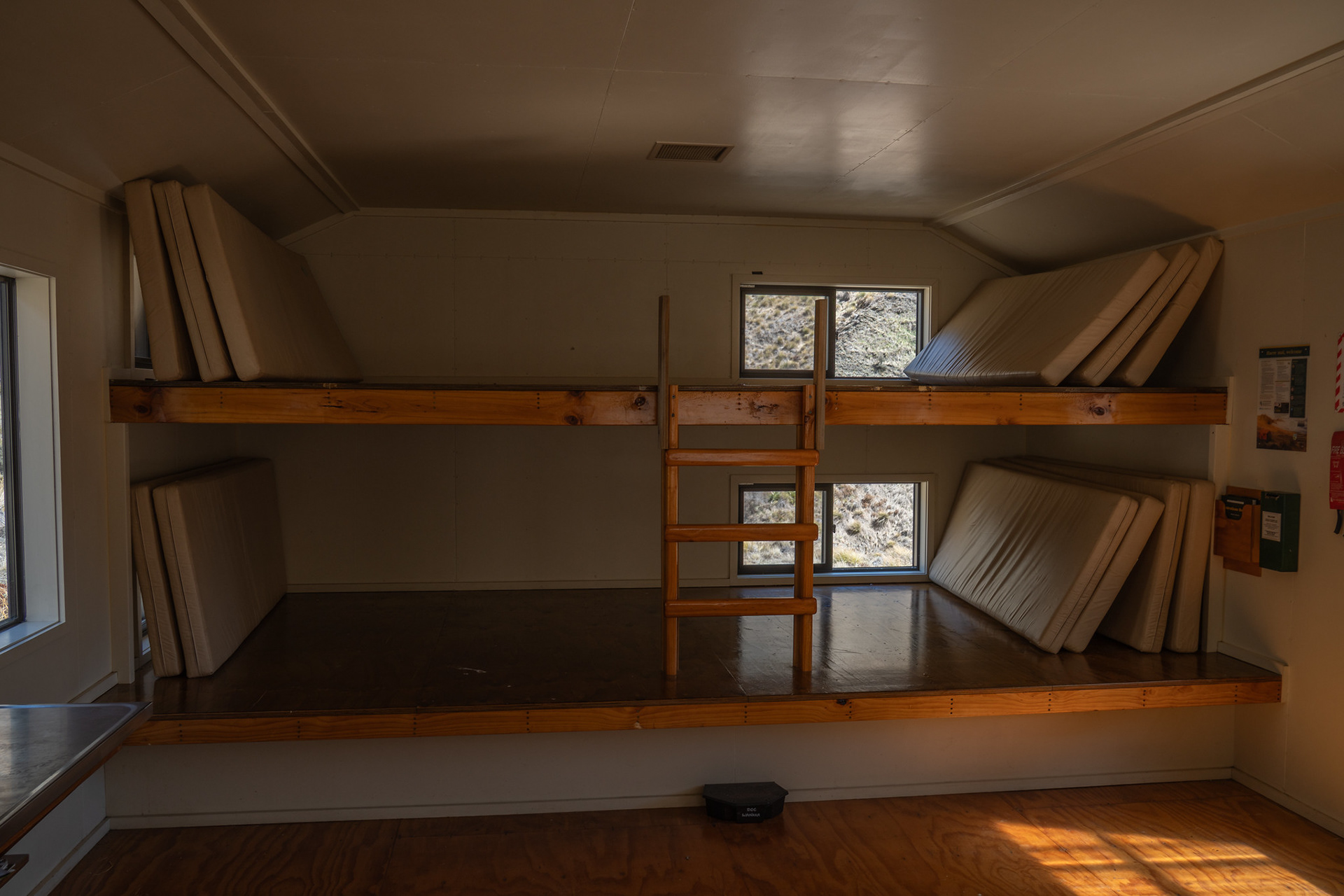
Sleeping quarters for Highland Creek Hut.
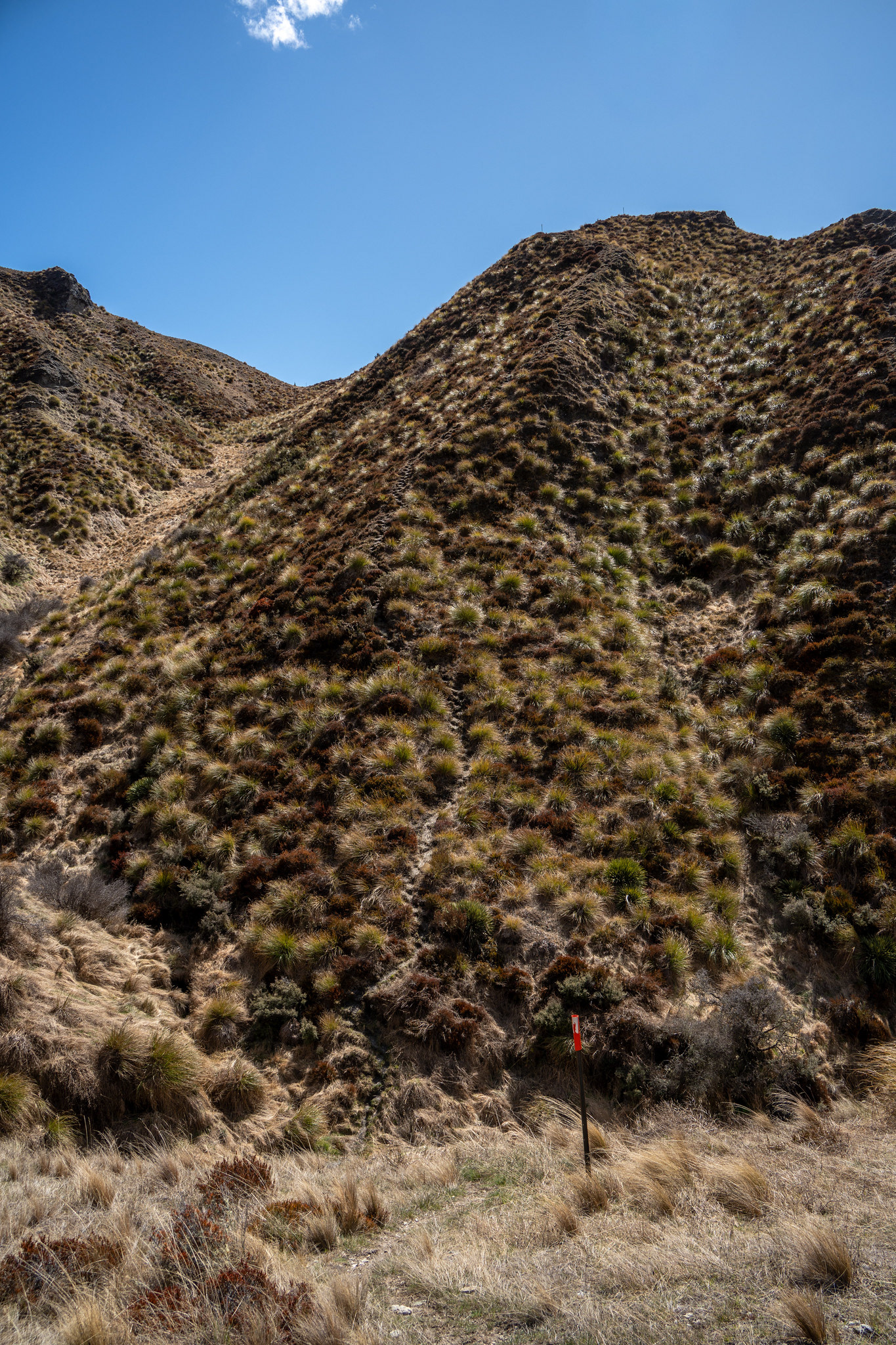
Setting out from the hut, the route immediately resumed the joyful oscillations. It drops down into Highland Creek itself, which can be easily jumped under normal conditions. It then travels downvalley for a short period, before climbing up the side of a spur, crossing its crest and then shedding basically all of the elevation just gained. That leaves you at the base of another spur, and a steepish climb straight up.

One of the steeper bits of spur to climb, soon after leaving the hut.
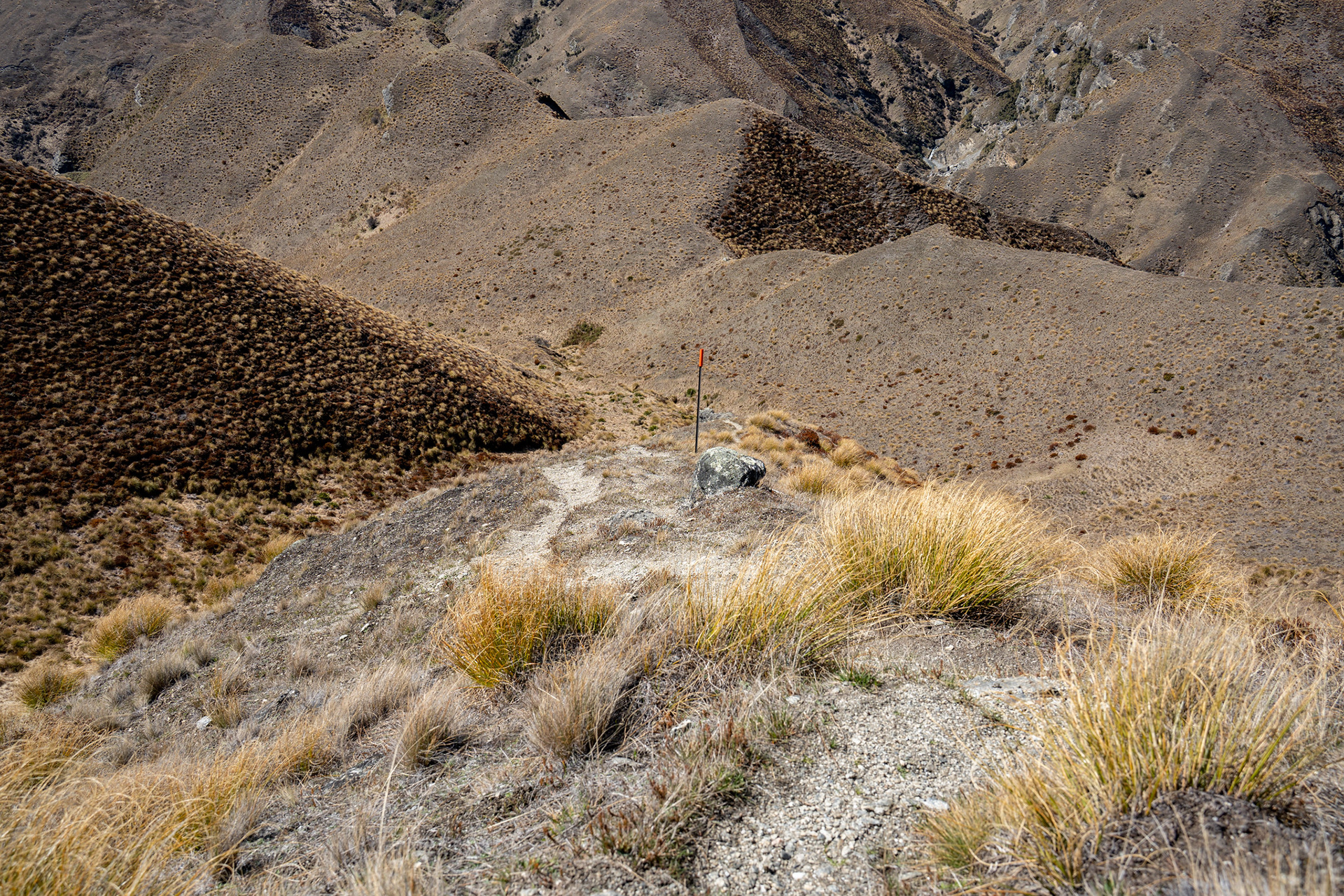
Once the steep pitch is completed, the trackbuilders have shown a bit of mercy and cut a level sidle across a short face and onto the more prominent spur beyond. This spur was pleasant travel, albeit extremely windy. Unfortunately I don't have much in the way of photos or videos from the second half of the day, largely because of the relentless gusts - was a constant battle to remain upright, let alone dig out the camera for some shots.
The spur goes up for a few hundred metres, then hits another spur which climbs a few hundred metres more. Motatapu is a bit of an enigma like that, sections of trackline which beautifully link complex topography and then sections of track which randomly sidle hundreds of metres to tackle a face which could be approached directly.

Looking back down another spur, hot work despite the high winds.
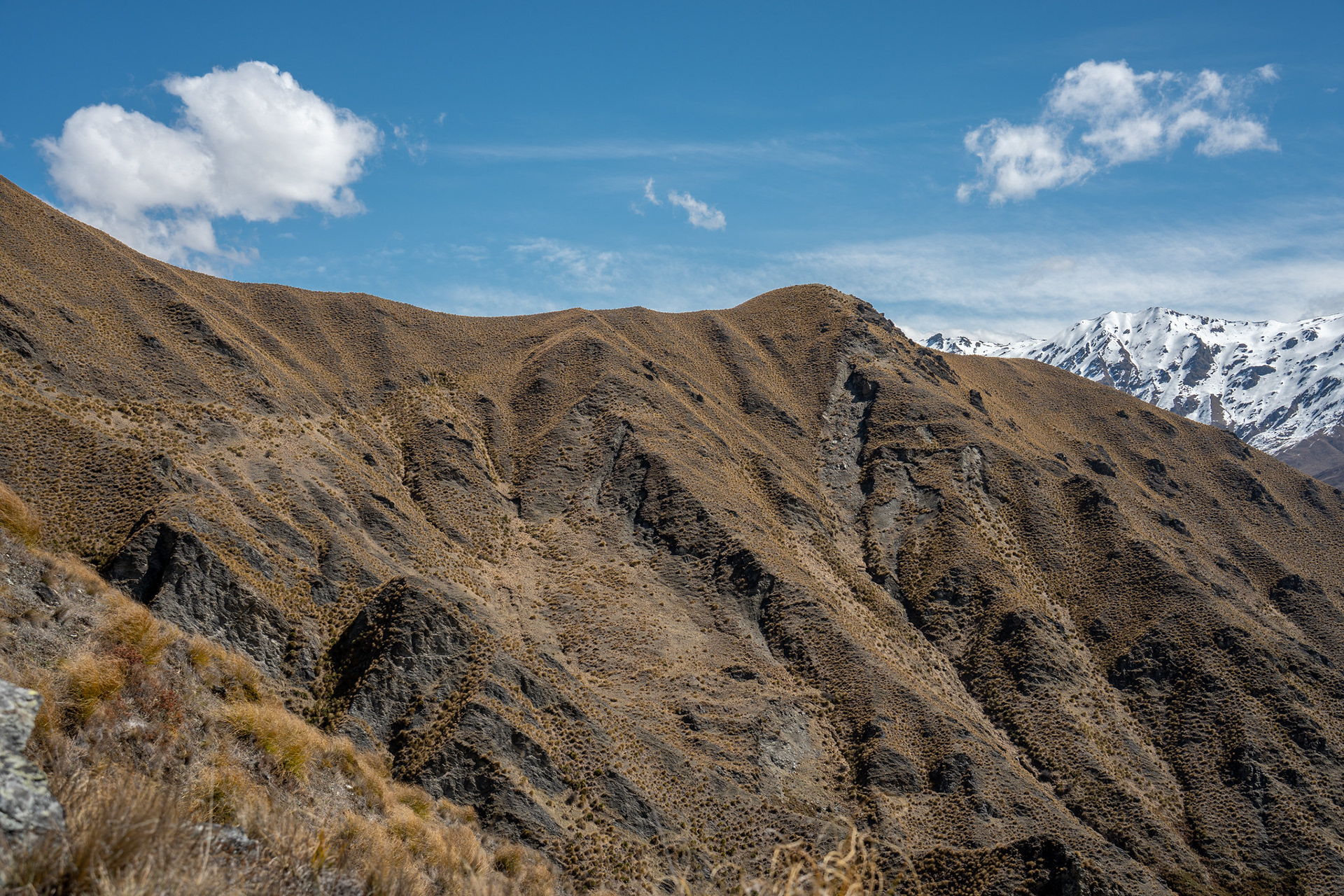
Somewhere around 1200m, the track swings right and begins a face sidle. There's a bit of literature online about this and the degree of exposure, but it's largely fine. Where the benched track is clear, it's perhaps similar to a narrower version of the Routeburn Track where it goes over the Harris bluffs - steepish country adjacent, but an easy path through. Where it does get a bit spicier is on the second half, where tussock regrowth has claimed portions of the footpad. Nevertheless, it's never wildly difficult though would require care in adverse conditions, particularly snow.

The approach to the sidle, which runs across the left-hand half of the visible face.
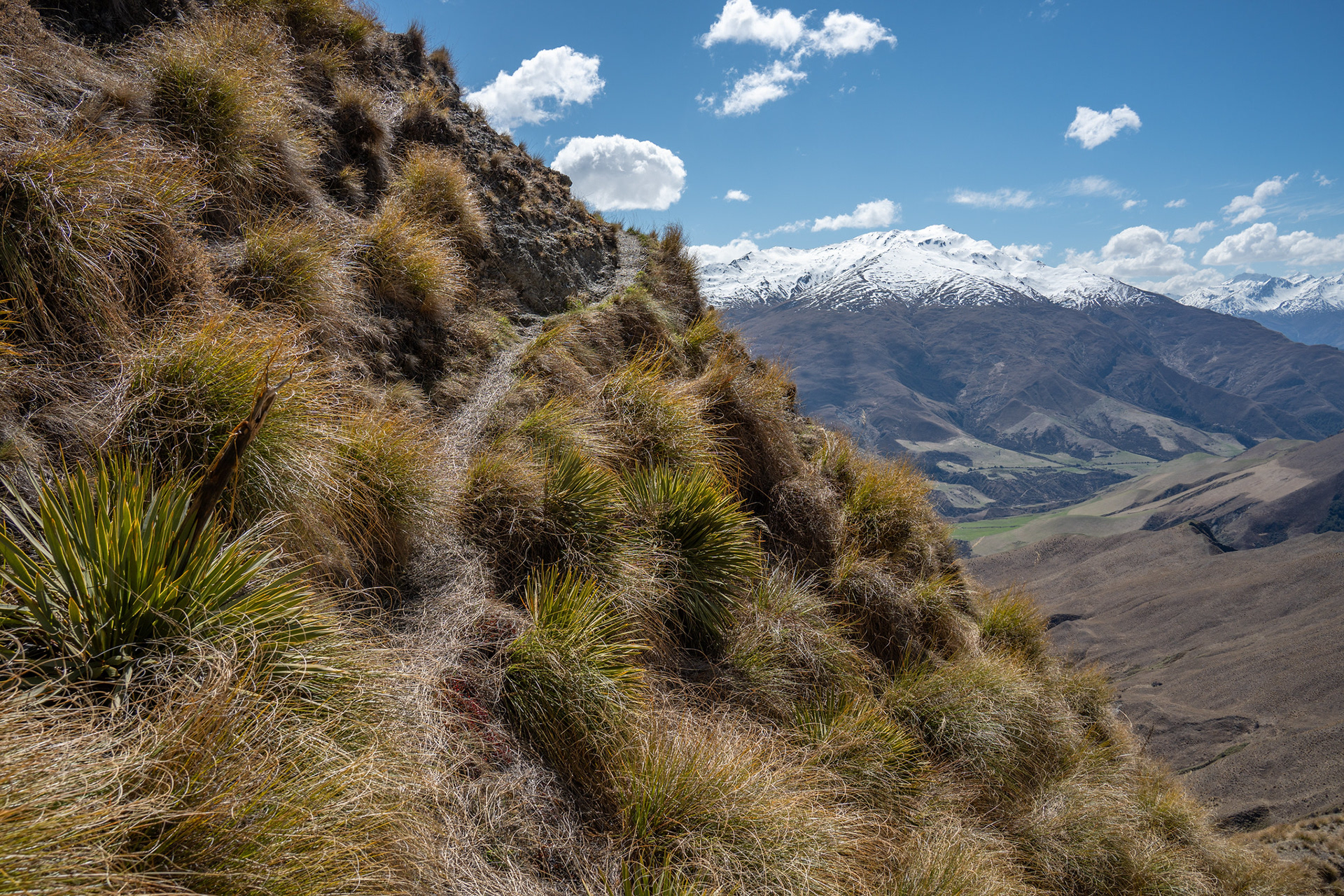
Sidling the face, good travel albeit narrow in places.
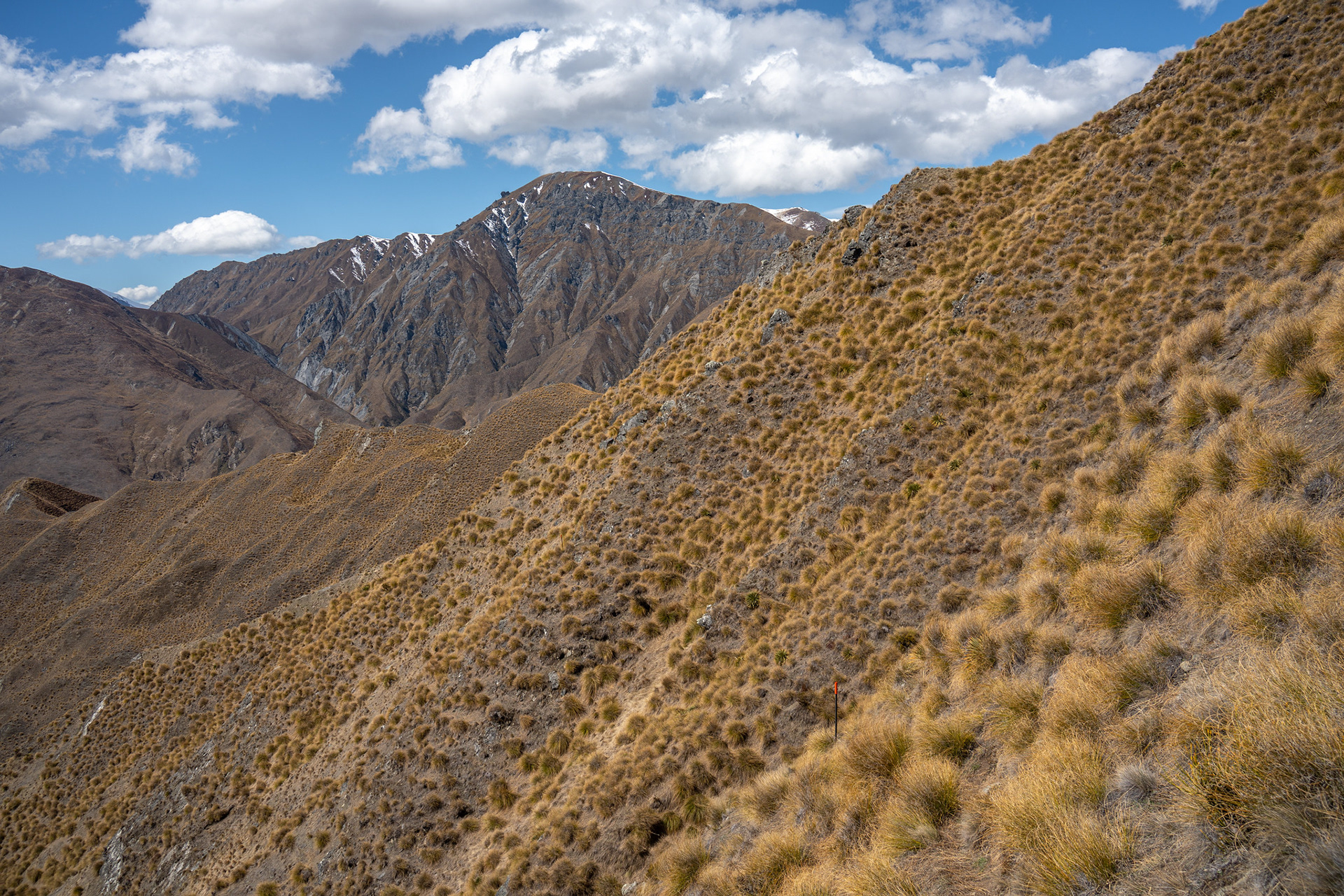
A look back across the sidle.
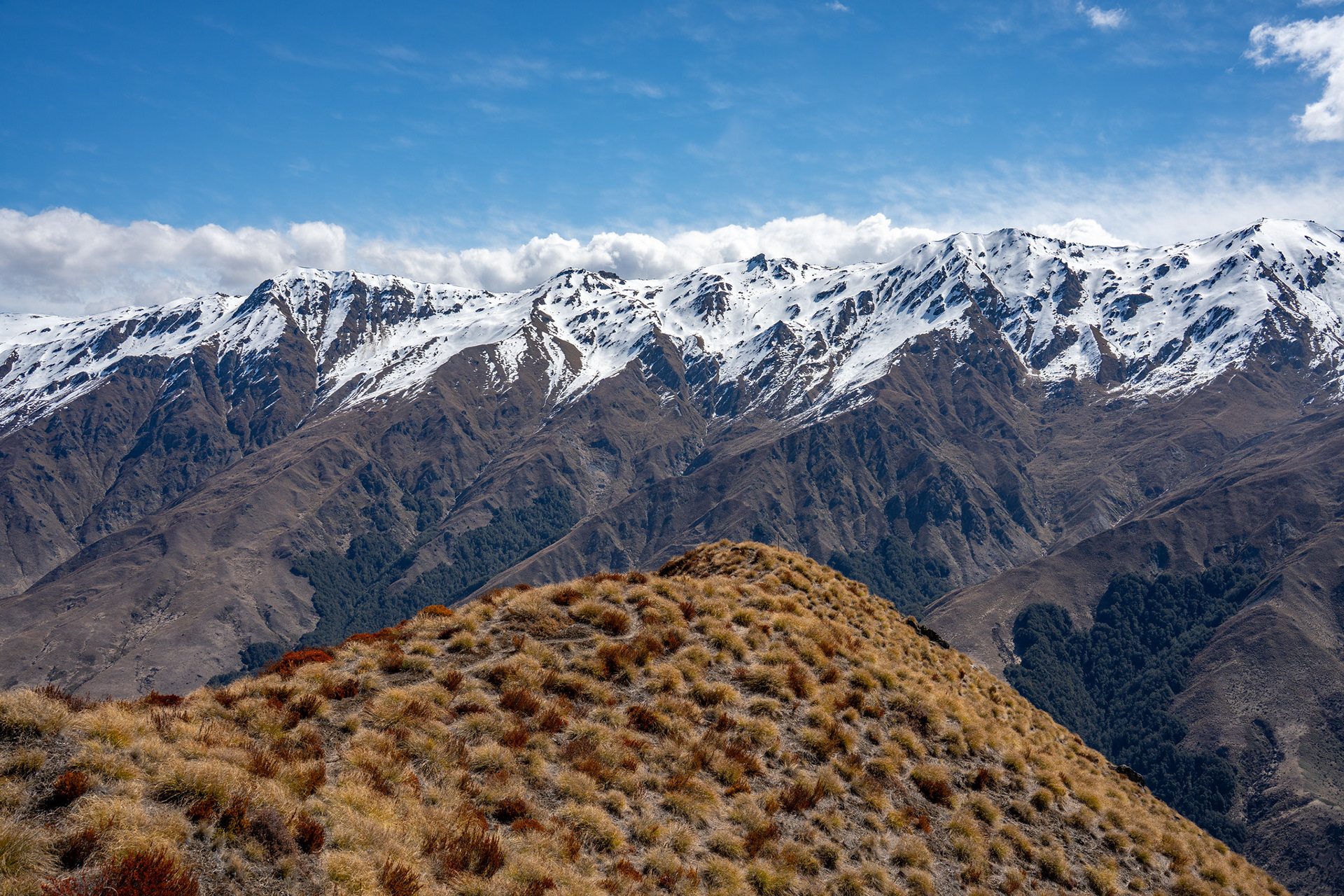
With the sidle done, the route climbs up to the spur crest and briefly descends before turning left and drops into a beech gully. This was probably the hardest part mentally of the trip, with around 1400m of climbing already in the legs and throwing away elevation which had to be reclaimed almost immediately. It's a slightly bitter pill to swallow being able to look right and see the river flats which ultimately hold Roses Hut, but sometimes you need to reflect on the wider gratitude for the access that is permitted.

Descending for a bit before turning left, the Motatapu peaks in the distance.
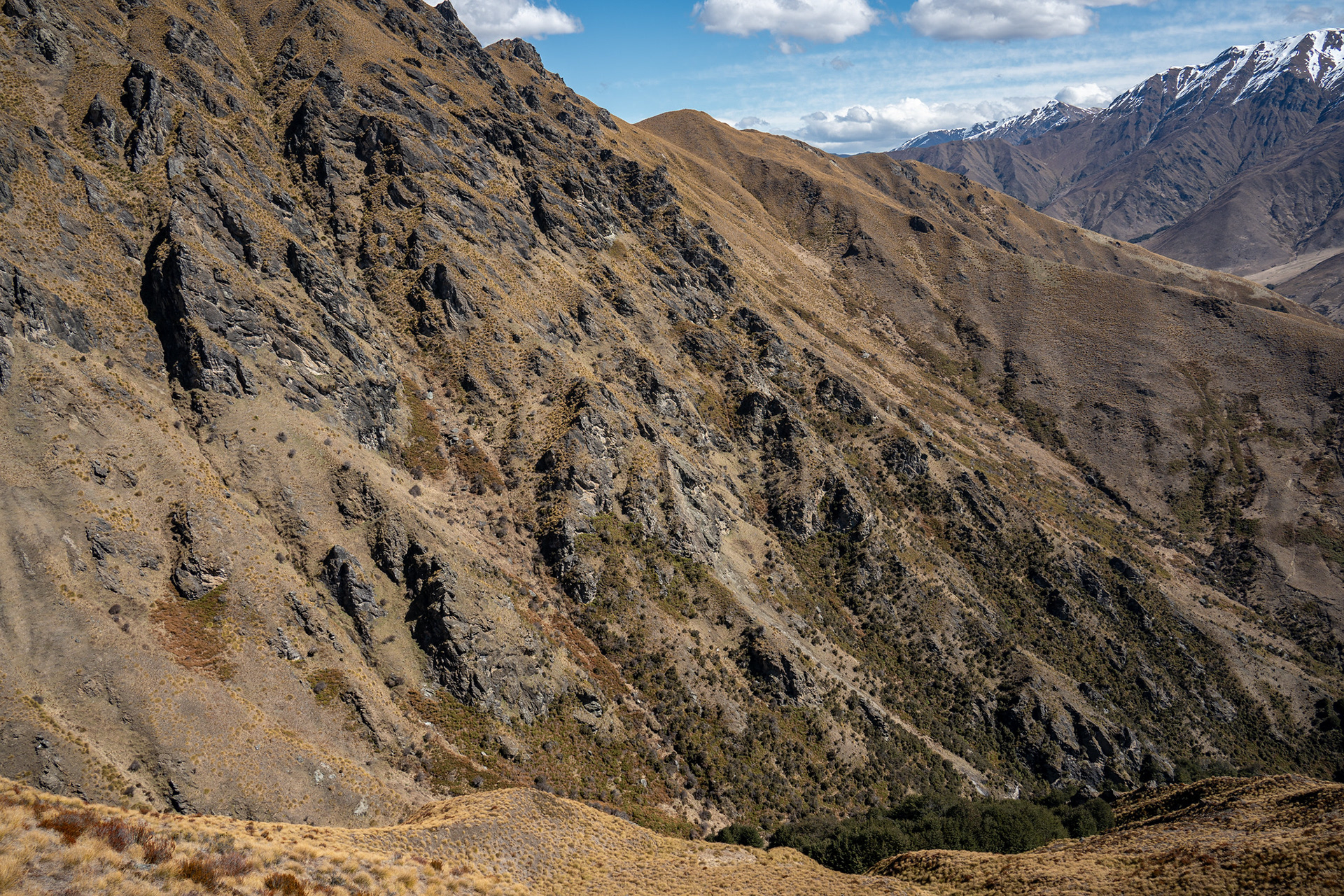
Anyway, the descent to the forest is reasonably straightforward, shallow tussock faces higher up becoming a bit steeper as the stream is approached. There's a nice dry-foot crossing of the watercourse, along with a couple of sawn trunks which provide seats and a place to snack and recover. It's also a chance to finally get some respite from the wind and the sun, gratefully received before commencing the last climb of the day.

Dropping into the beech gully, the route then climbs onto the right hand spur crest and crosses behind the outcrop studded face.
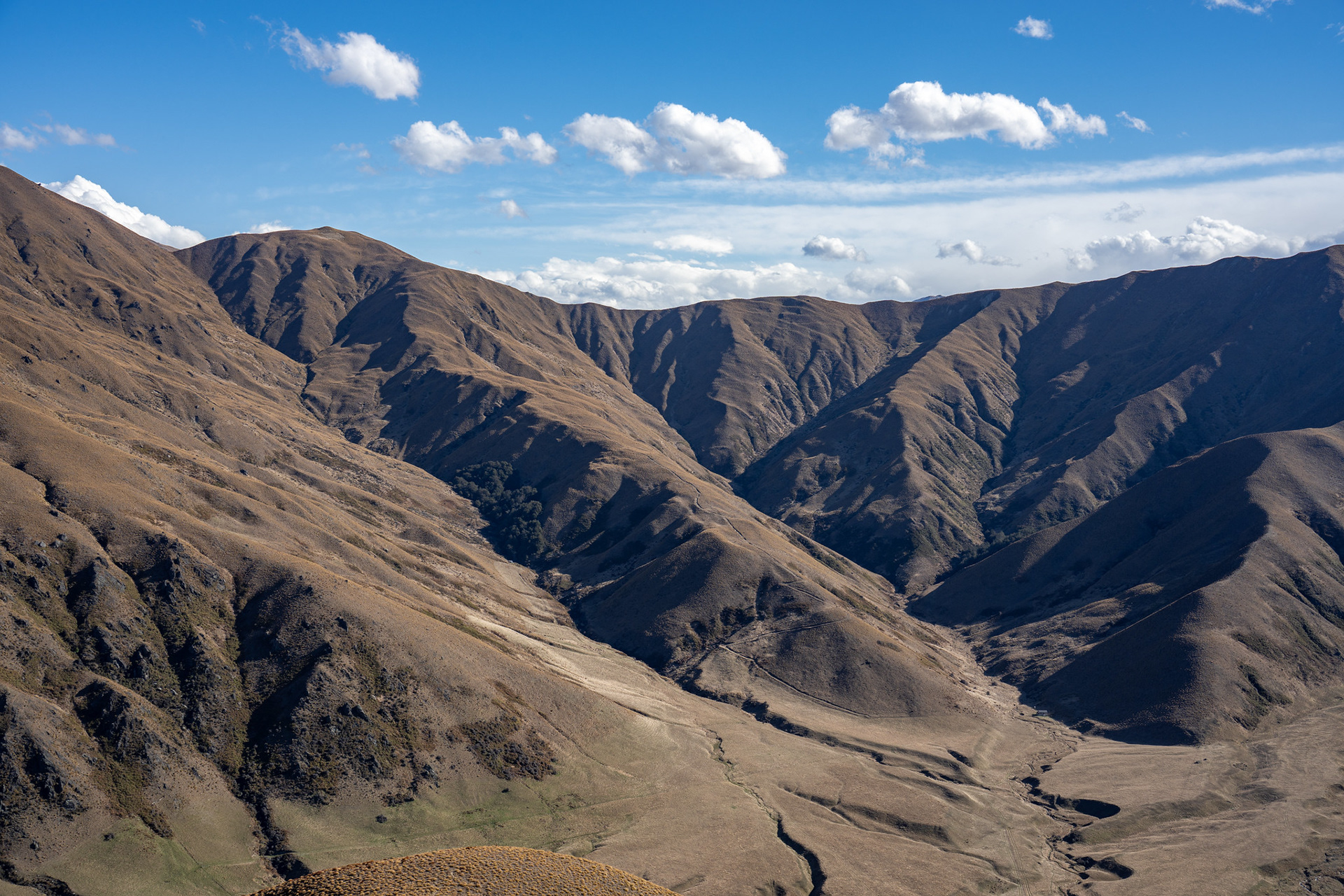
The climb back out of the valley floor is quite steep to begin, but it soon flattens and enters scraggly scrub beyond the beech margins. It's a bit difficult to follow in places and the marking a bit light, but with care it broadly leads up and left before unexpectedly turning hard right and sidling at a constant elevation for a few hundred metres. I don't really understand what the motivation was here, the direct face approach looked easy enough and even a rising traverse rightward would have been a nice middle ground. Even worse, the long sidle ultimately leads to shallower ground which is seemingly to the local rabbits' liking, as a lot of the switchbacked track has been destroyed through rabbits burrowing. Alas, that's enough complaining for one day.
The route zig zags up to the spur crest, turns left and climbs until a short right sidle leads to the ridge crest proper. It's a nice setting and the views are lovely, but also very exposed to the wind - luckily there is a fence for parts of it which stops you being blown down the far side of the ridge. A few nondescript kilometres brings you towards the toe of the ridge, and some back and forth down the face leads to the flats of the Motatapu.

The first view of Roses Hut, in the bottom right corner just left of the far-right spur.
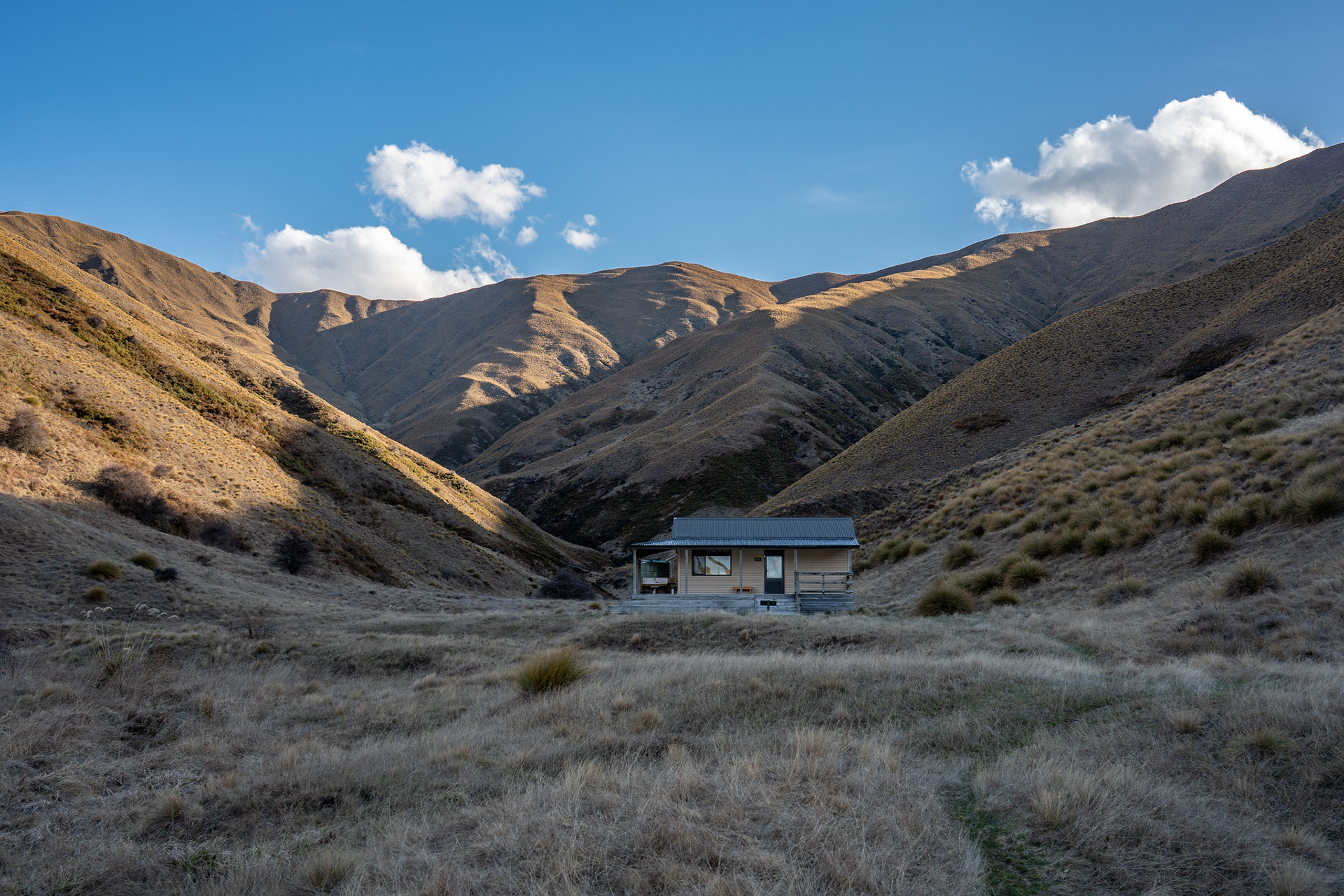
Roses Hut is visible for the final few kilometres, but there is one obstacle - the south branch of the Motatapu River. The track crosses the river at a vehicle ford, and somebody has created a rock bridge out of boulders. In lower water, this might be a good dry-feet crossing but with the rivers up a bit, it wasn't really viable. Even the wet-foot option was quite punchy in the flows of the day, something to be mindful of if you're passing through during rain. A few minutes of flattish walk after the ford leads to Roses Hut, the last stop of the trip.

Roses Hut sitting amongst its short grasses.
Roses Hut, like the other two, is a 12 bunk structure with water tank and toilet. The setting is probably a bit less magnificent than the other two, looking down the flattish valley floor of the Motatapu. It does feel a bit more frontcountry, with vehicle tracks adjacent. It's not a bad place to spend the night, and probably a bit nicer than the other option of pushing through to Macetown.
It was time for an early night, as Sunday was always going to be tight. Roses Hut to Arrowtown is circa. 25km with 1000m of climbing, though about 12km is on 4WD tracks which helps the pace. I had done the sums on timing - it was a 4pm flight, probably needed to be at the airport by 3pm to get through security in time for boarding, the last viable bus from Arrowtown was at 1:57pm. The DOC timing is 4 - 6h to Macetown and then 3 - 5h out to Arrowtown, so the initial plan was to set out at first light (~7am). The initial route out of Roses is old 4WD track, so I decided to upsell that conservatism and leave around 6am. Plenty of time, right?
The concern levels rose a bit during the evening, as the rain swept in quite heavily. It was somewhat forecast, different models had initially picked heavy rain before they sort of settled on a consensus of light rain. The main crossing of the route is the Arrow River, which can't be avoided and comes just before Macetown. Ultimately, I just had to sleep and hope everything worked out in the morning.
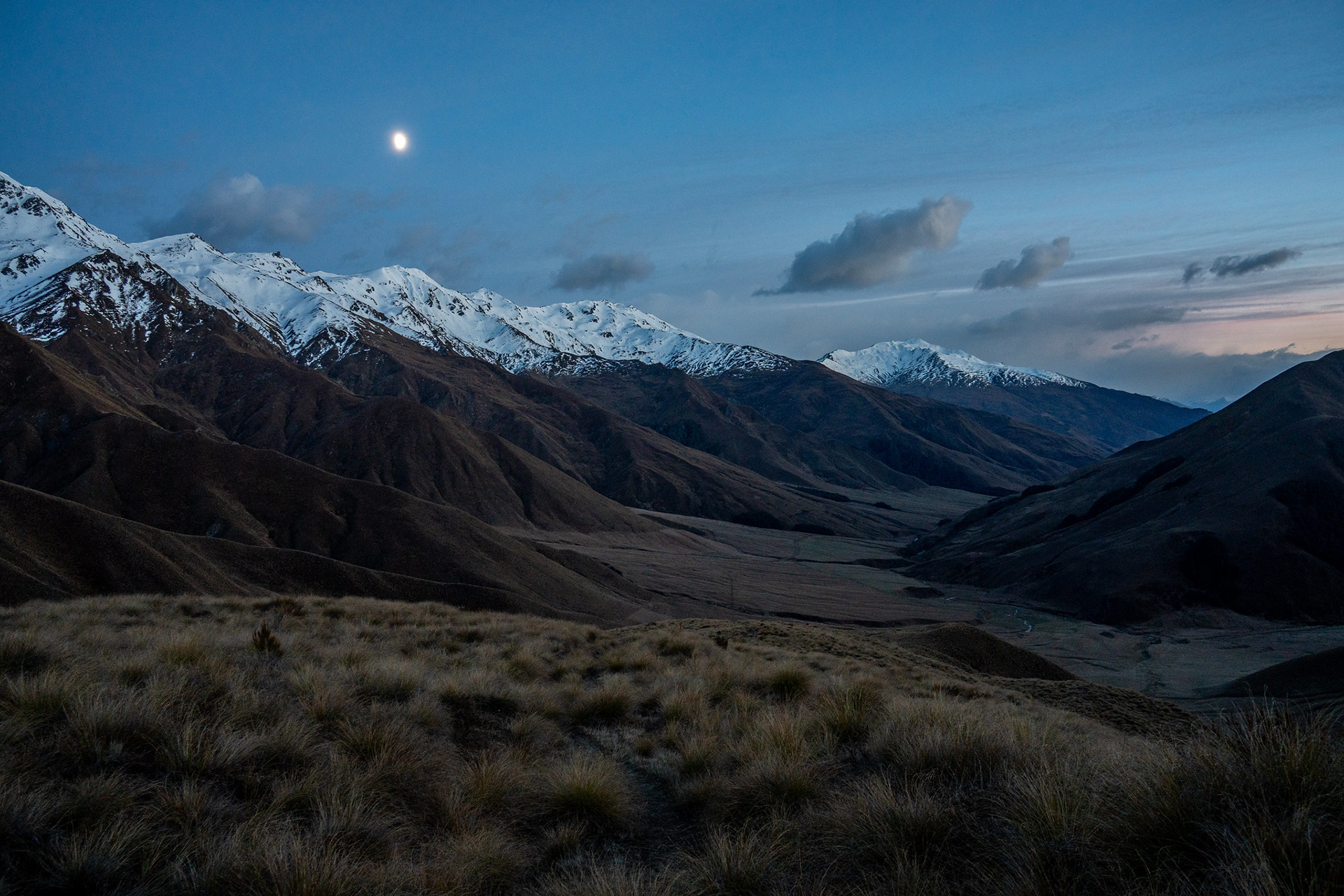
I did rise at a respectable time, and was out the door a few minutes after 6am. There's a short section of tramping track across to the 4WD track proper, which is not really viable as a vehicle route anymore - some of the track just parallels it. It does present a chance to tick off the elevation up to Roses Saddle, in quite pleasant conditions. Moderately warm, less wind, a nearly full moon giving way to a muted sunrise near Roses Saddle.

Looking back into the moonlit Motatapu.
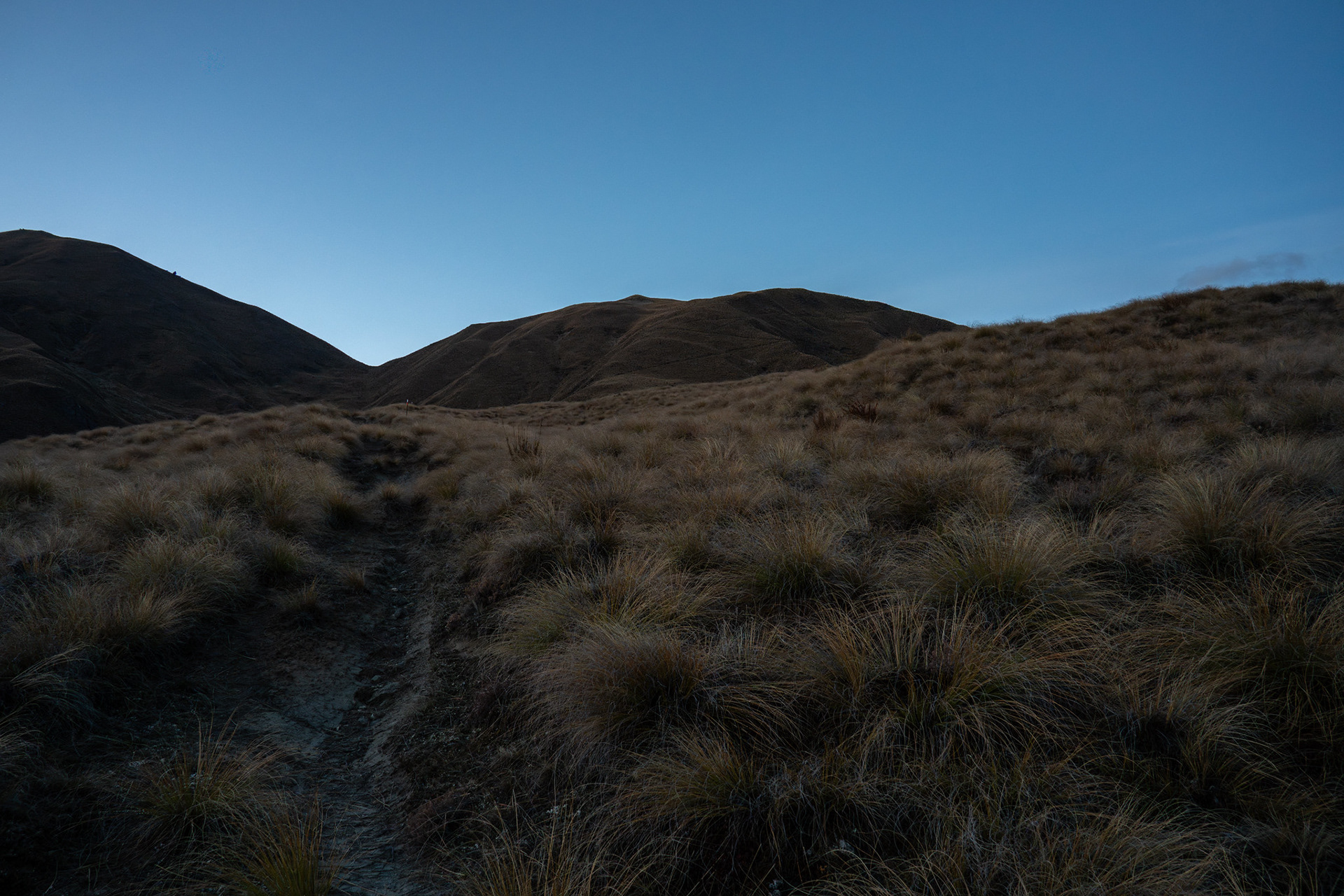
The gradual climb up towards Roses Saddle.
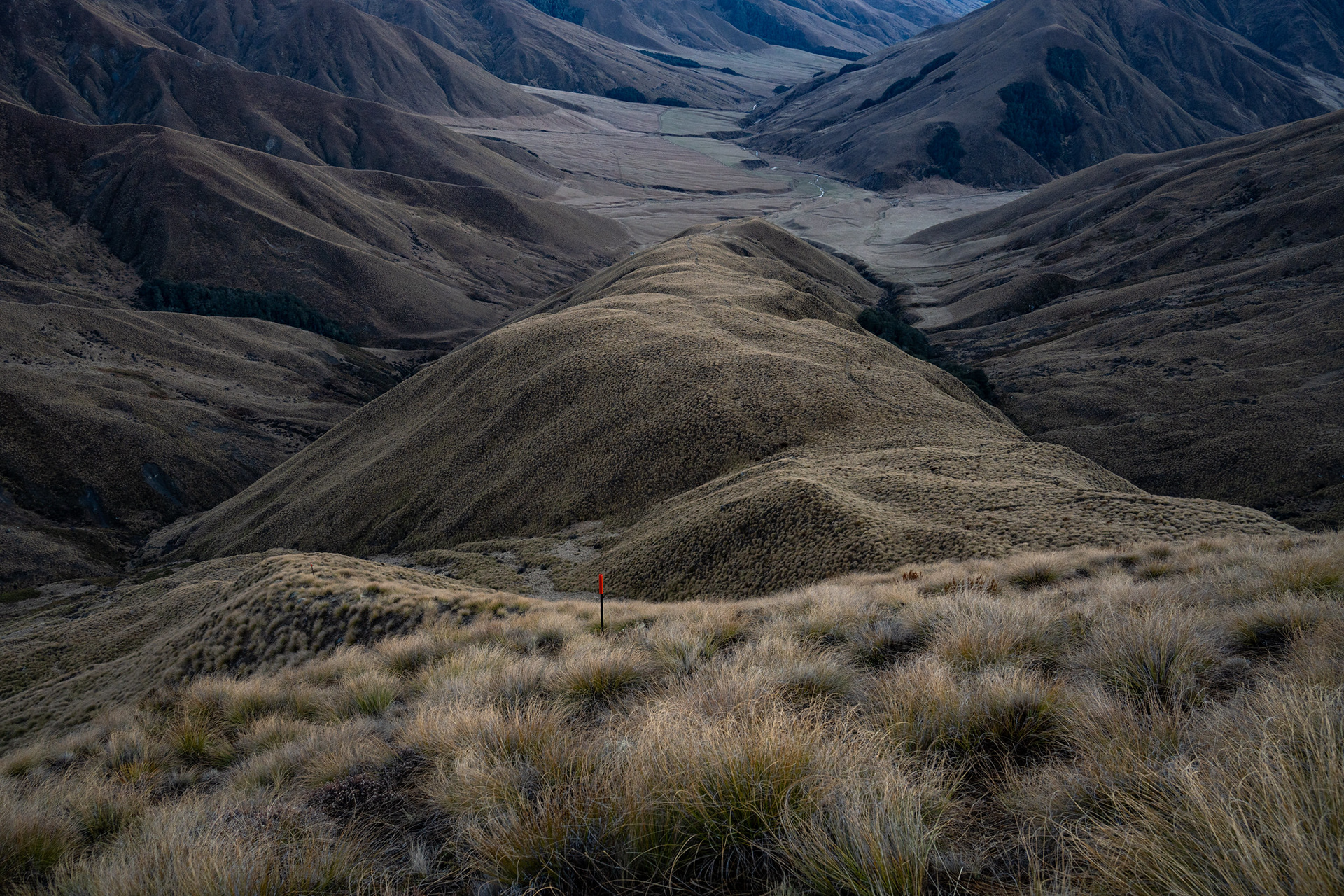
Looking down the ascent spur as it snakes its way up.
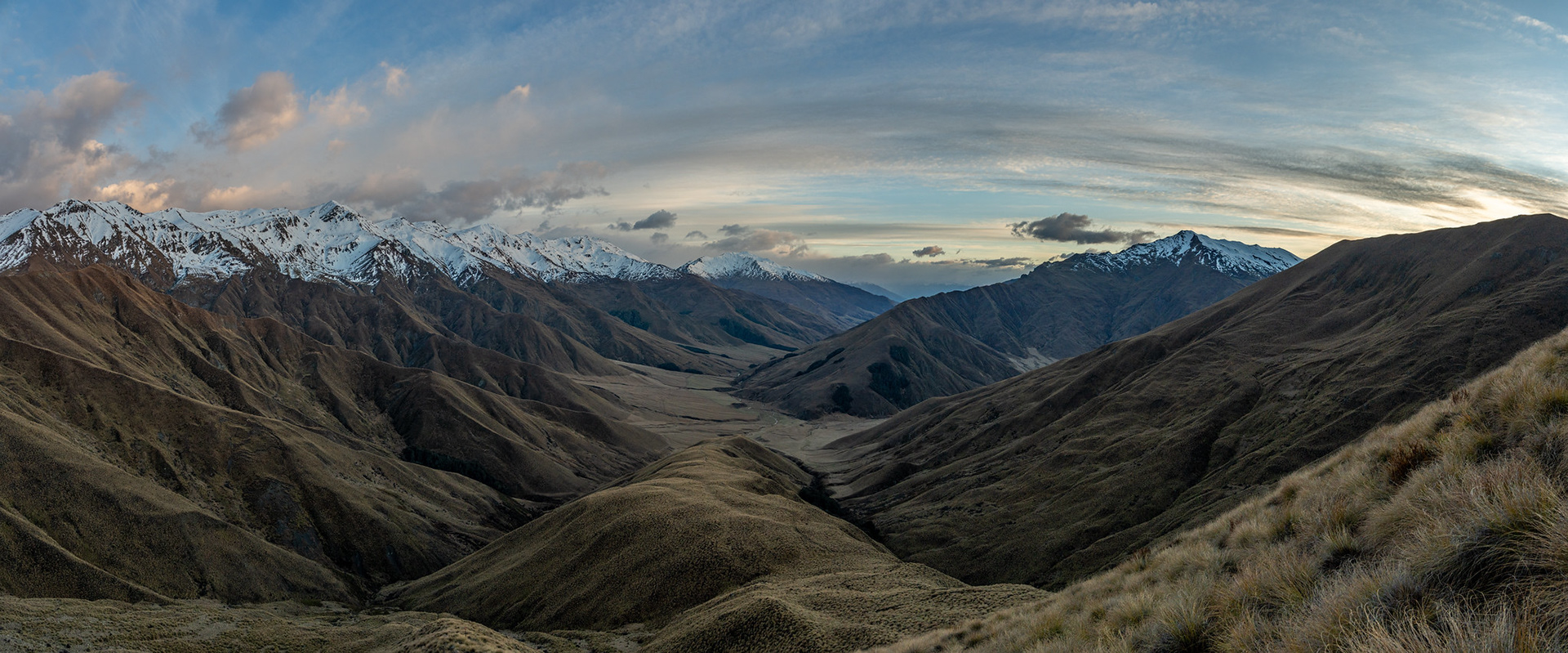
A wide angle view of the Motatapu region, Knuckle Peak on the right.
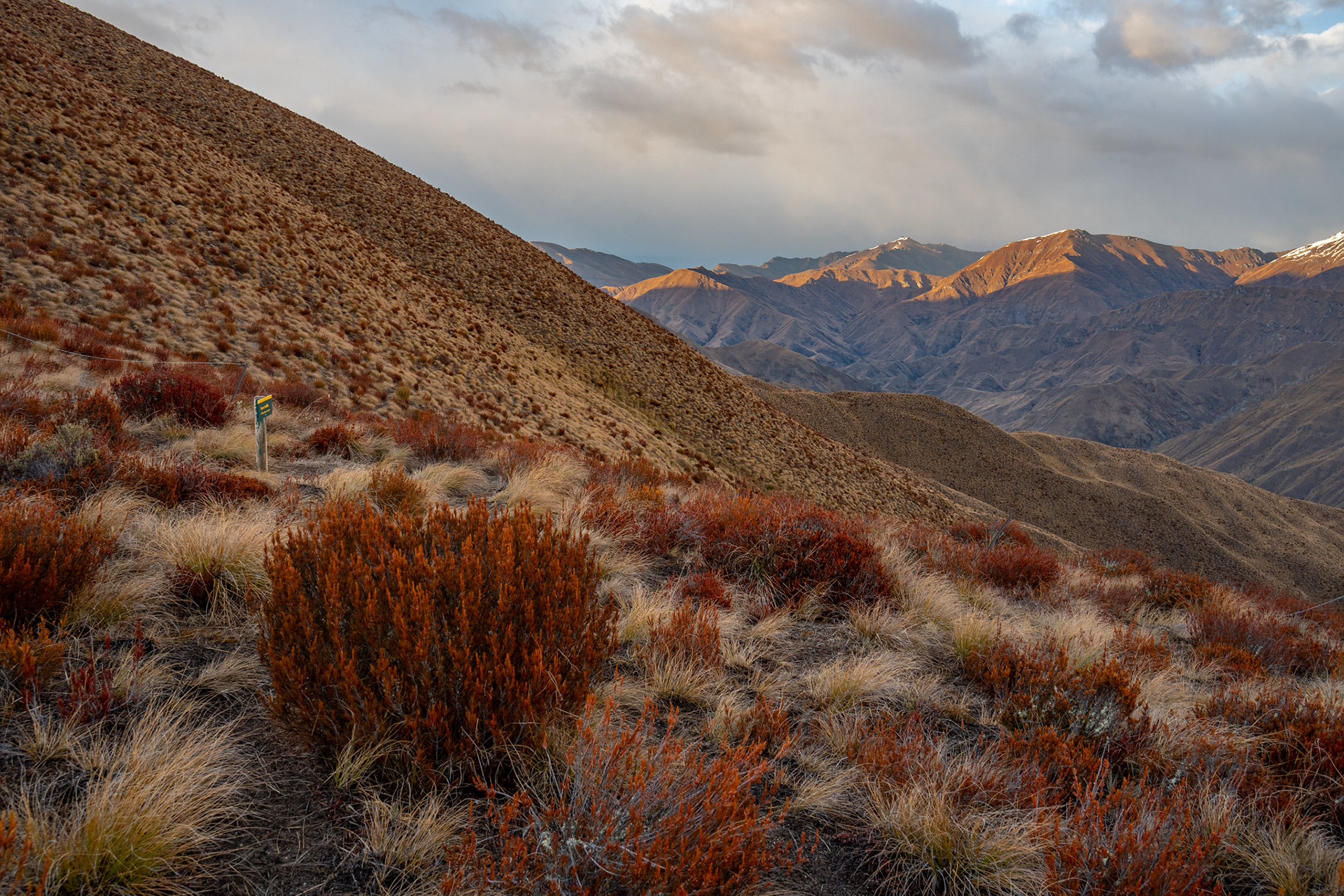
Once the track passes over the ridge (a short distance from the saddle proper), the change in setting is quite pronounced. It goes from pastoral landscapes to a less tamed, tussock-rich setting with vistas into the barren upper Arrow catchment. There were goats for company, but otherwise it was me and my thoughts as the track dropped down over pt. 995 and to the Arrow River.

Dropping into the Arrow catchment.

One final view of the Motatapu Valley, the early sun illuminating the peaks.
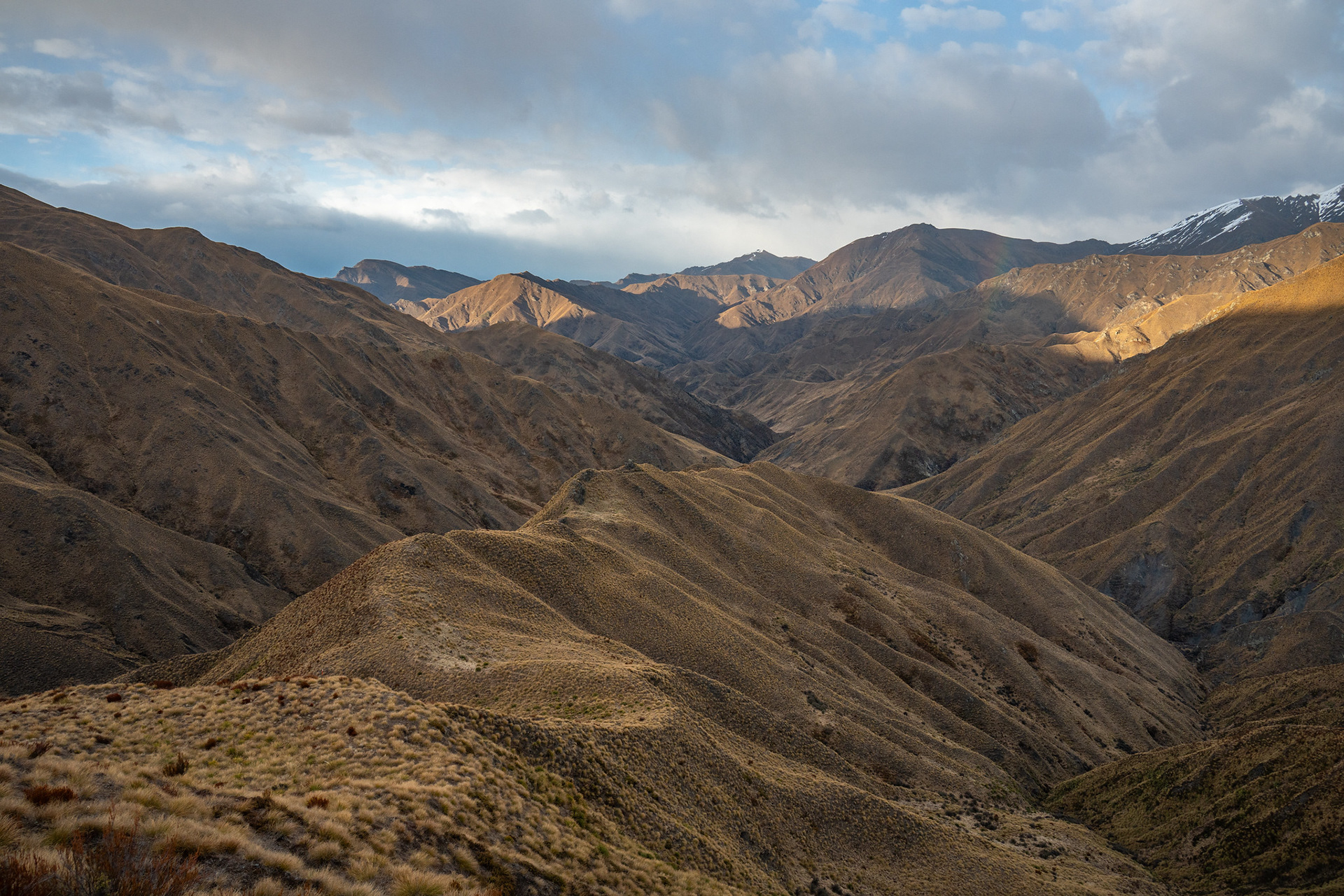
Dropping down the prominent spur, pt. 995 below.
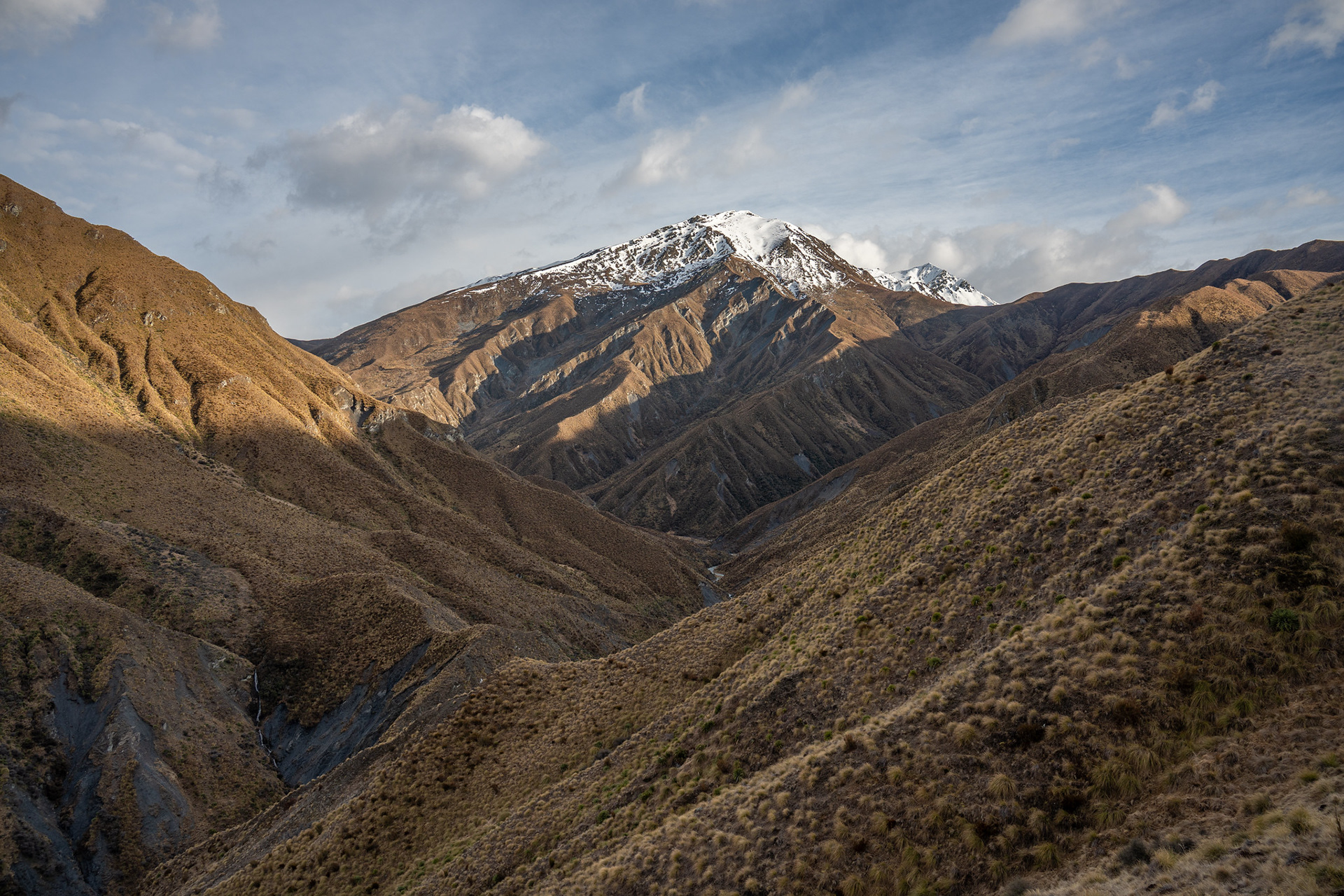
Up to pt. 1781.
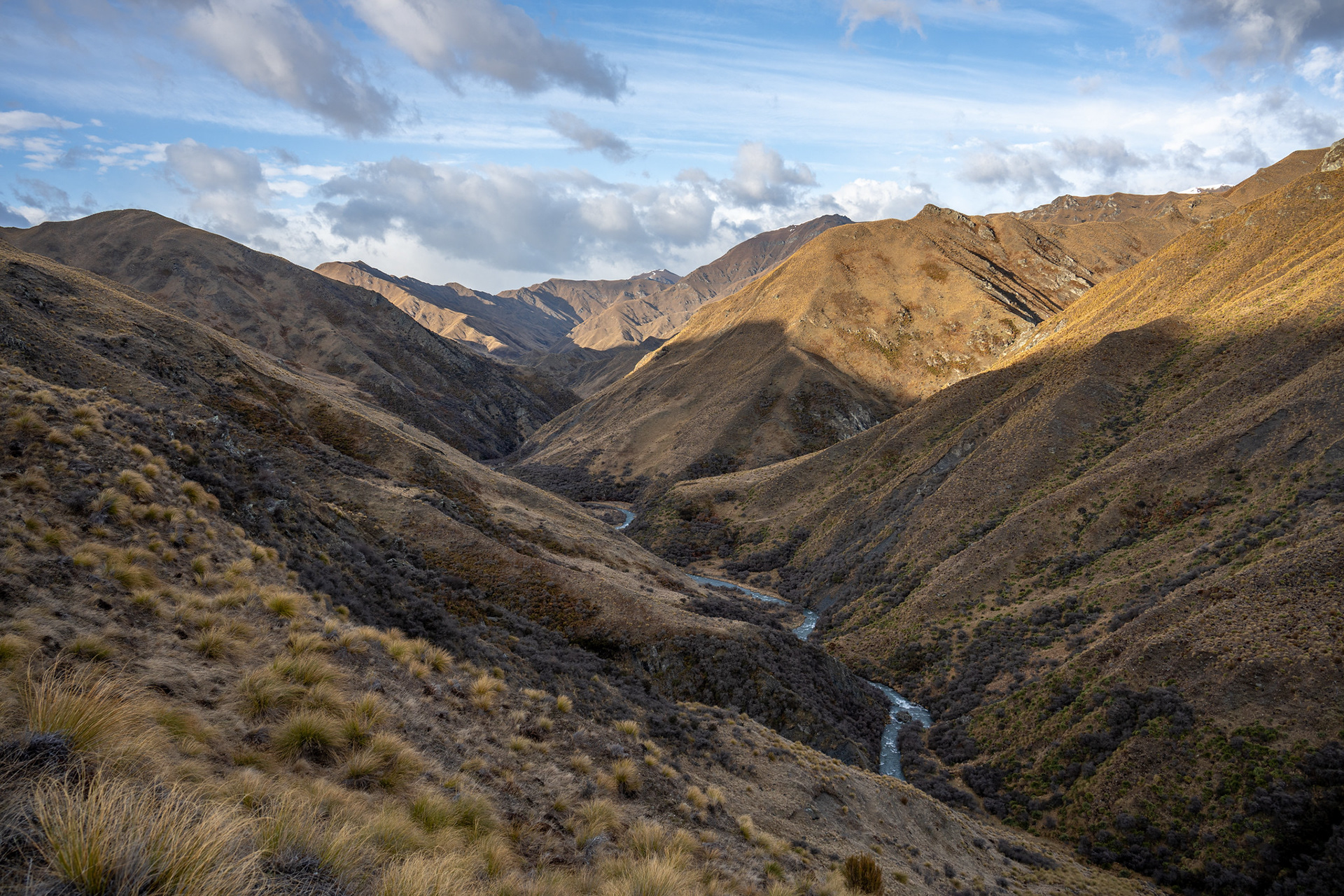
The middle reaches of the Arrow River flowing through very barren landscape.
As the river is reached, there's a sign indicating a low level / high level demarcation. The Arrow River was too high to be reasonably crossable, so I took the left and went high. If you're passing through in summer and the river is low, definitely stay low near the river - not only does it cut off a lot of climbing, it also avoids the matagouri horrors that await on the high route.
The high route was gratefully received as a contingency option, but it's hard going in the current state. Lots of ups and downs, it adds around 250m of climbing and the gully tracks have been heavily reclaimed by matagouri and assorted dense scrubs. If you're looking at the GPX tracks included with this, you're better off ignoring some of the trails and trying to best navigate off the waratahs. It's never impossible, but it's scratchy and arduous which wasn't exactly what I was hoping for given the tight timeframe.

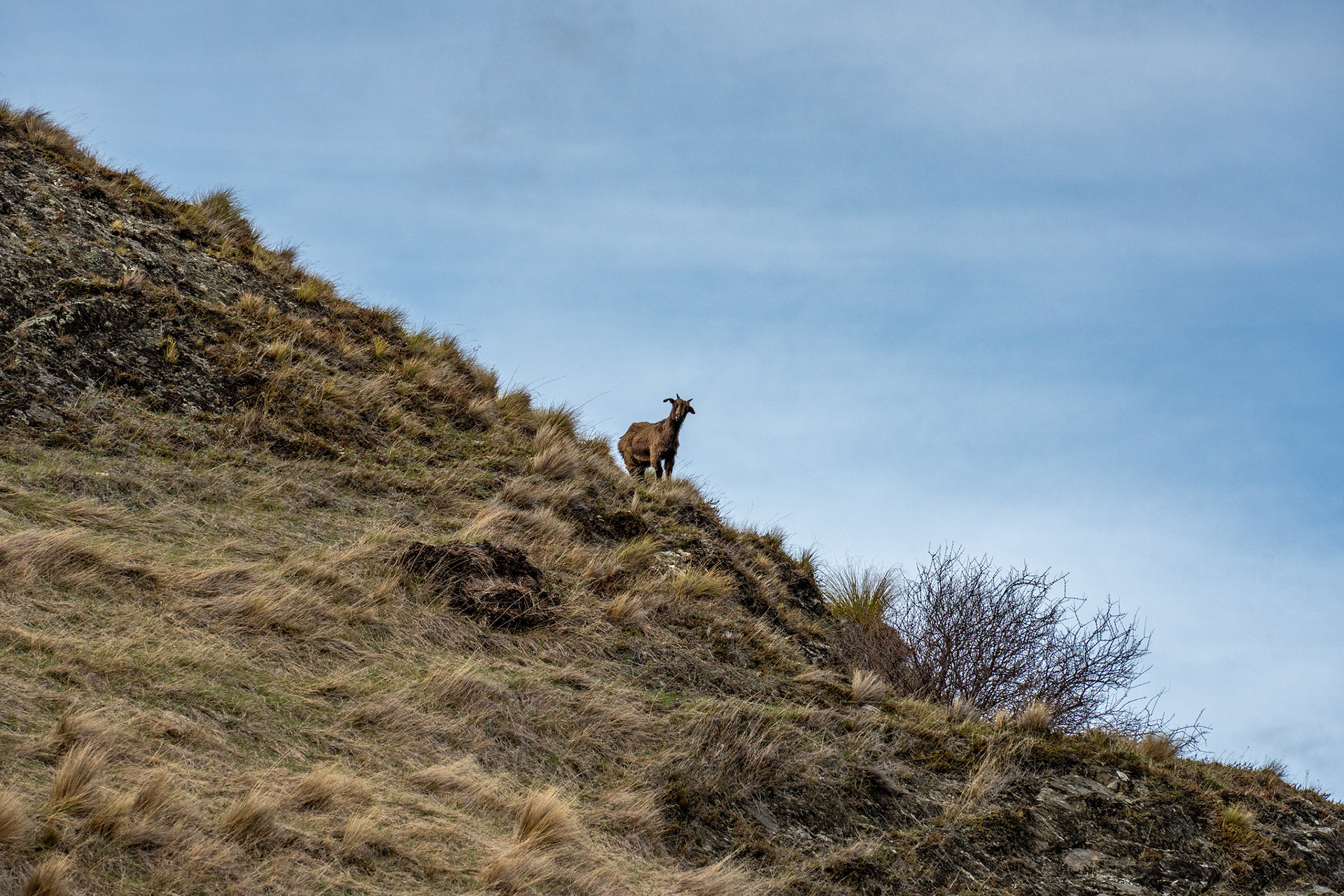
No pictures of the matagouri sorry, but here's a goat with piqued interest.
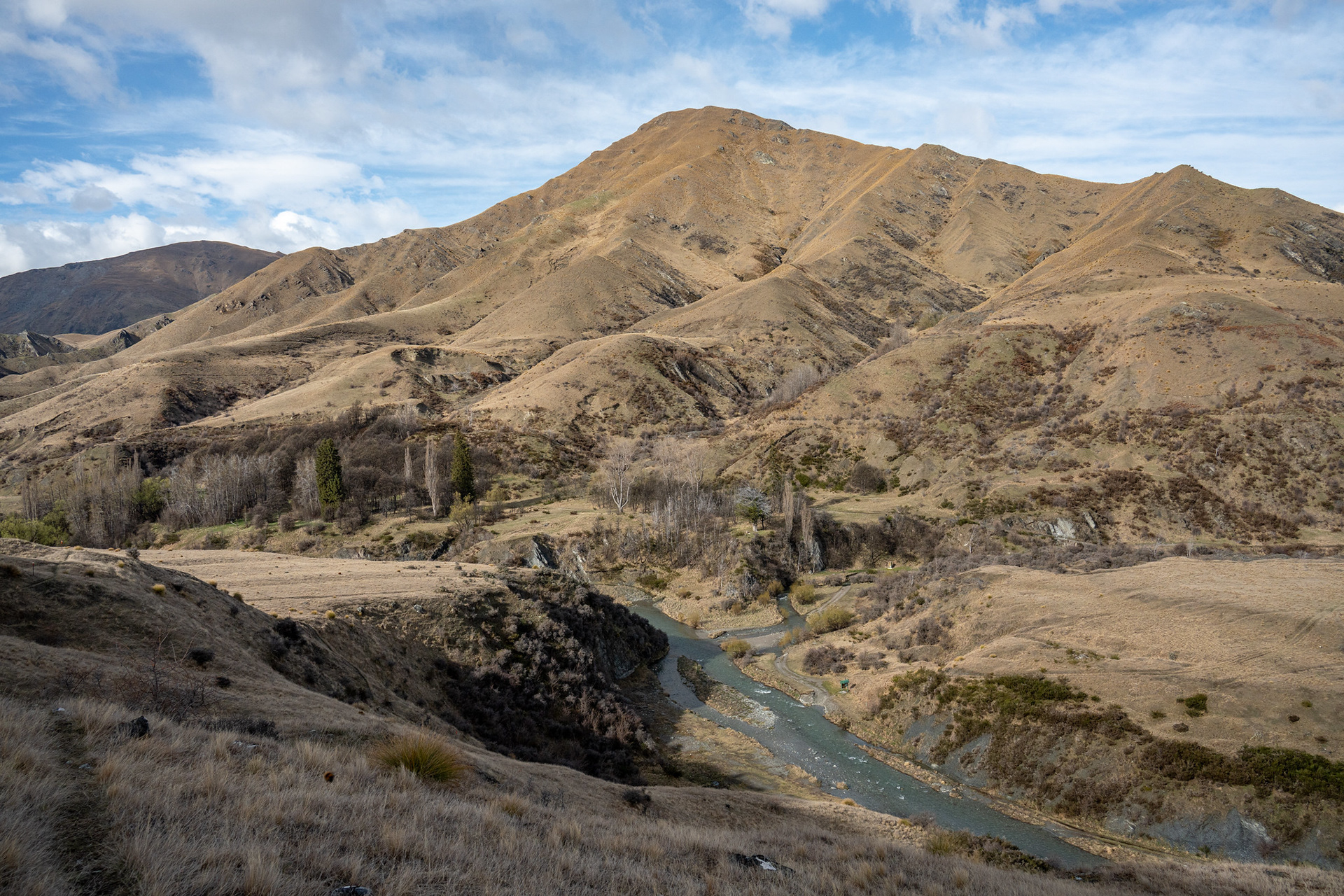
Eventually, the gullies are passed and the route resumes face travel in short tussocks before some gentrified travel down to the Arrow River by Macetown. The DOC description is a bit confusing here, but I believe it's quickest to ford the Arrow River, then Gold Burn and then turn left and follow the river down for a direct line to Macetown. For most, it's better to just ford the two rivers and then turn right, taking the 4WD track that goes up and around a hairpin to access the abandoned settlement.
The worries about the Arrow River ford were somewhat justified, the river was up compared to its baseline levels but still a viable crossing. While river conditions do change, as this stage it's probably best to ford it slightly upriver of where the track hits - the trackline is vehicle scoured which makes it quite deep, and trying to cross the braid with the central island forces you down a bit to the Arrow / Gold confluence which is also quite deep and has awkward recirculation flow where the two streams collide. There's a better stretch maybe 10 or 20m upriver, where it's moderately wide and between river riffles which allowed a reasonably swift crossing just above the knees.

The final descent to the Arrow / Gold confluence, both rivers need to be forded.
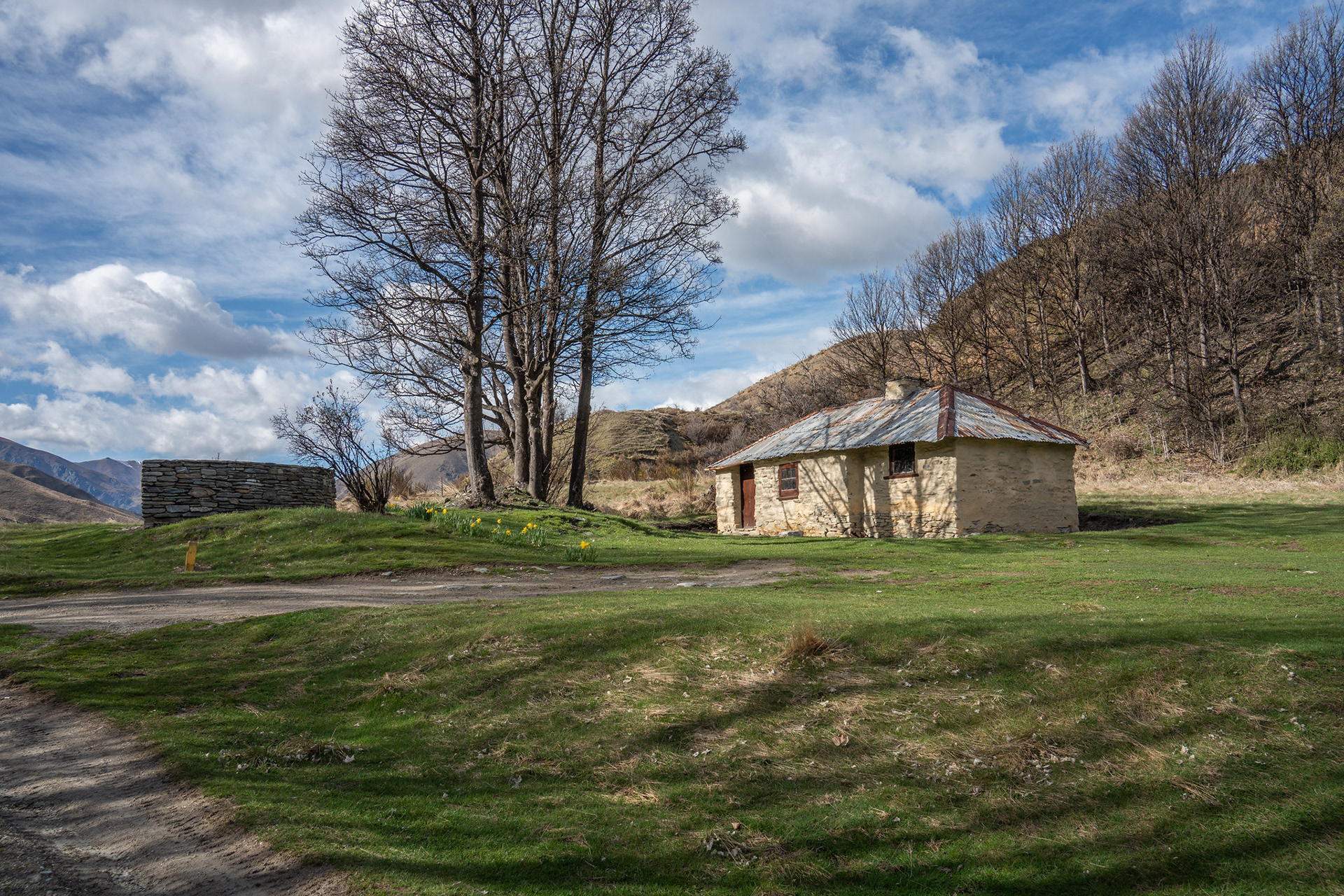
Gold Burn itself is also not trivial in higher water, but it went and I was soon at Macetown. Normally this would be a spot of relief, as there are no more compulsory crossings to be made. However, the day was marching on quicker than I was, so dreams of a break were shelved and I started down the 4WD track.

Some of the old architecture at Macetown.
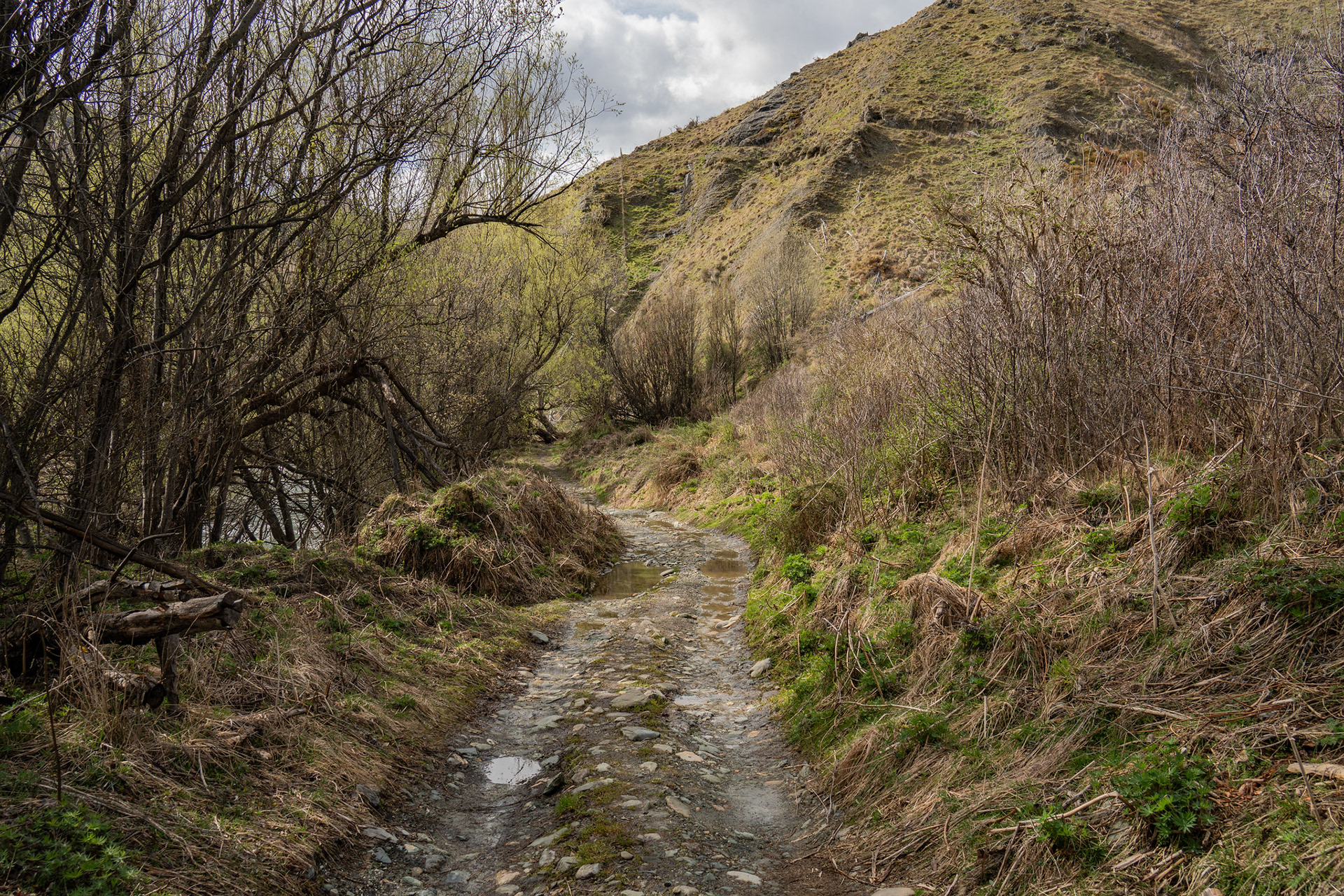
The first couple of kilometres are easy travel on a terrace, before the 4WD track swings down into the river. There are a couple of sections of the TA trail which cut surprisingly high above the true right of the river to avoid the crossing, before Coronet Creek is reached. If you have time and the weather is nice, exiting over Big Hill is probably a more scenic option from here. However, I had neither time nor the legs for such an option and continued downvalley.

Ambling down the Macetown Road, it's a bit of a monotonous haul though there are lots of goats.
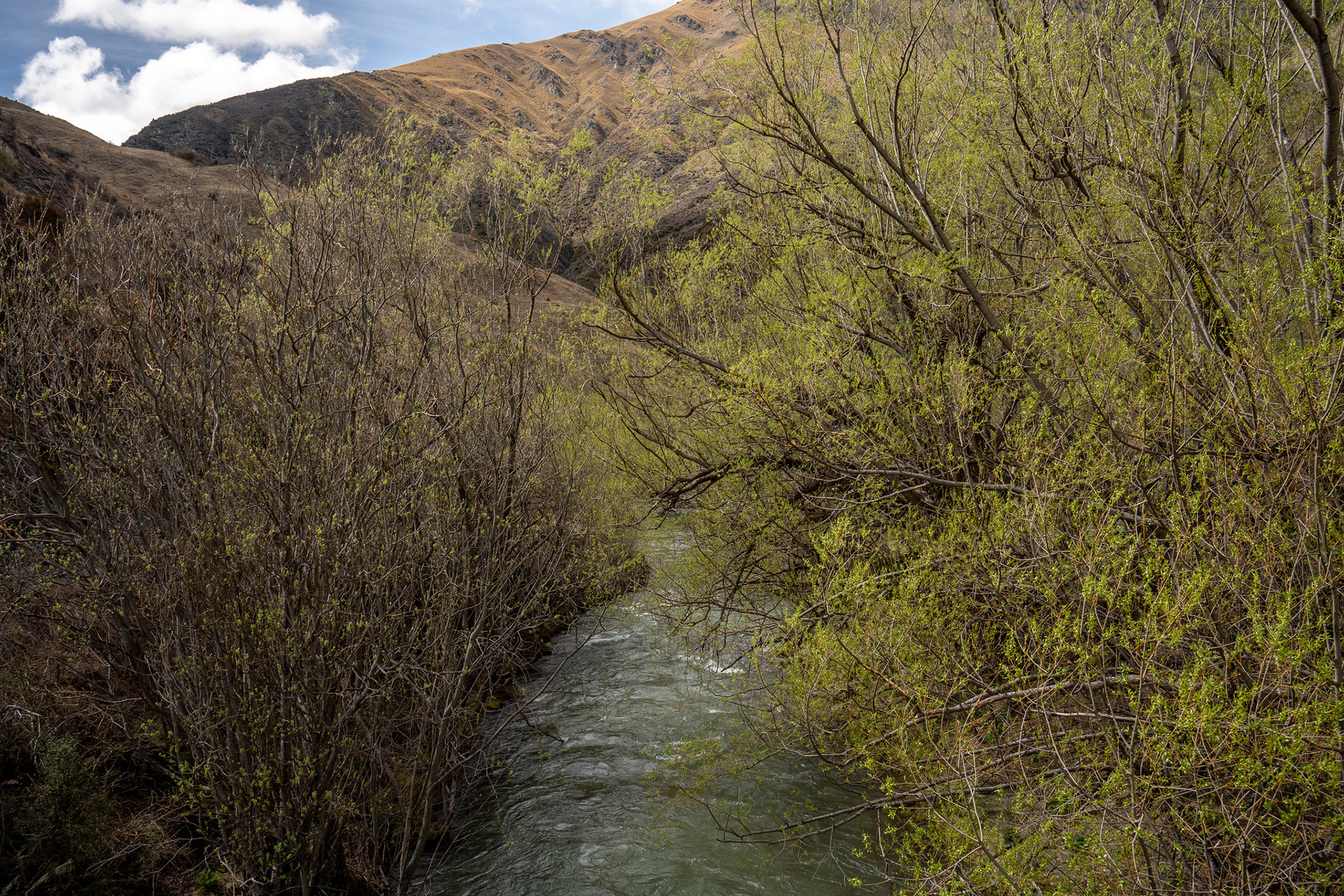
The Arrow River passing through willows, classic Otago scenery.
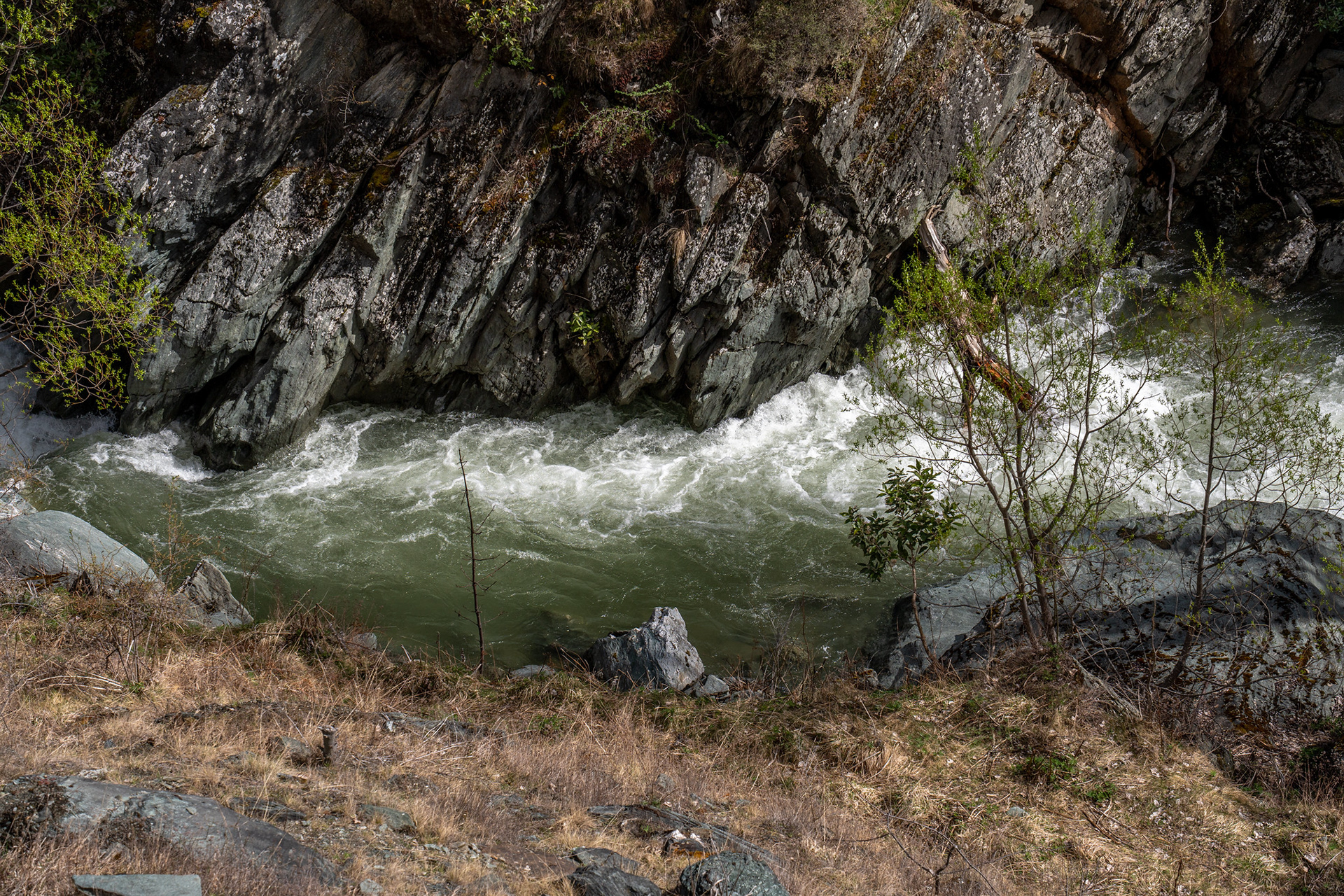
Mercifully, the entire valley below Macetown is passable without crossing the main Arrow River. The short section of 4WD on the TL around CB11 7159 2102 can be avoided using a mountainbike trail which stays on the TR, and the crossing of the Arrow River near Soho Creek is bridged despite not being shown on the topo map. The crossing of Soho Creek is also bridged, and from there it's a cleanish run down the Arrow Gorge. The gorge is quite a barren and unwelcoming place, made me all the more appreciative for the 4WD track and rapid egress.

The depths of the Arrow Gorge, you can see why they built the road so high.
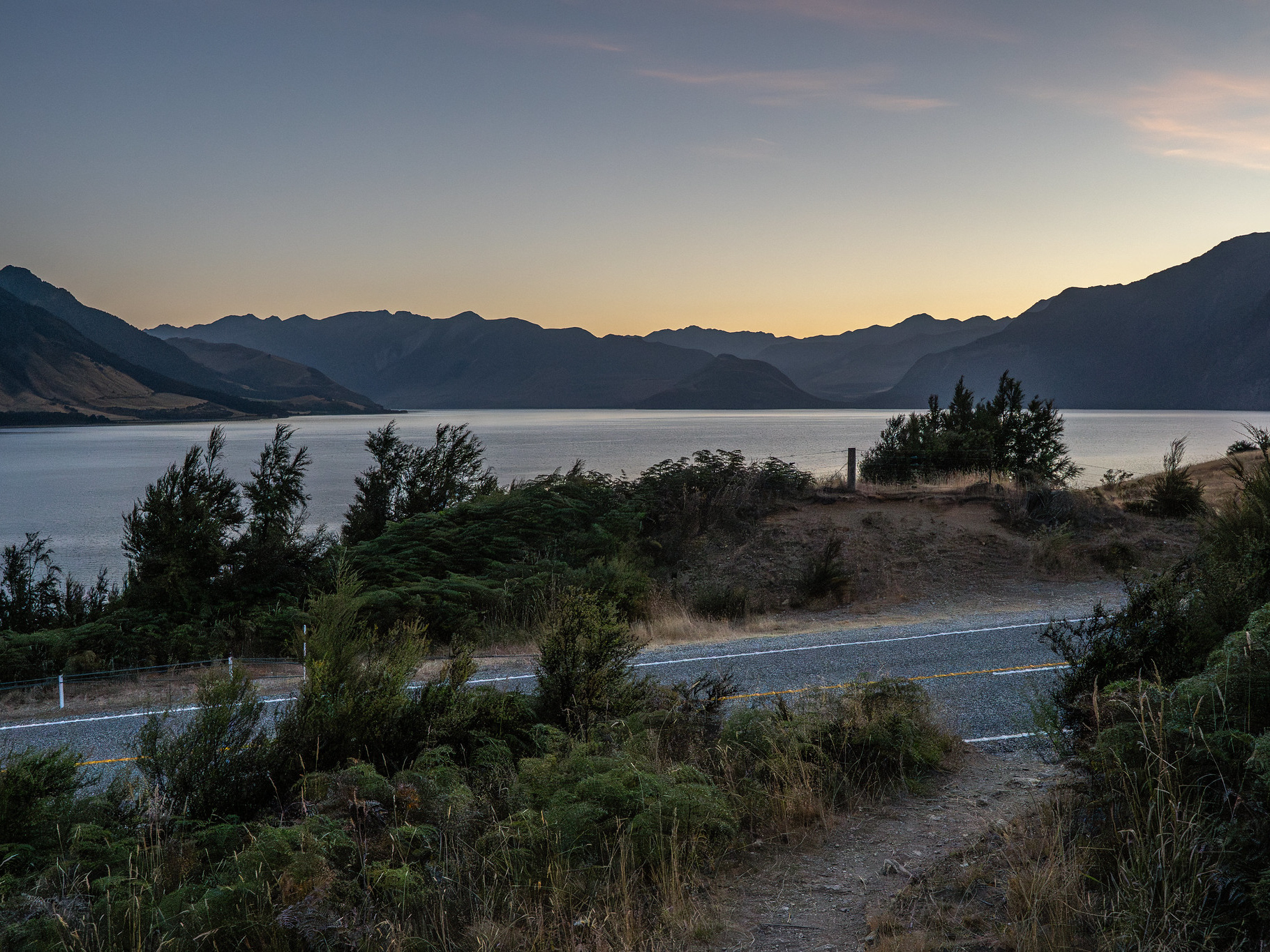
Around CB11 7179 1668, taking the pedestrian bridge over the river leads to the Arrow Gorge walking trail. There's a short albeit brutal climb as you exit the bridge, but it soon levels off and becomes palatable as it ambles the final few kilometres to civilisation. It's a bit of a stark contrast too, exiting the backcountry after three days to suddenly find yourself in a carpark with hundreds of others milling around one of NZ's most expensive suburbs. All that was left was to browse the local Night and Day (sugar-free Gatorade was a new experience!), and wait for the bus that began my long journey back home.

You may also like

Back to Top